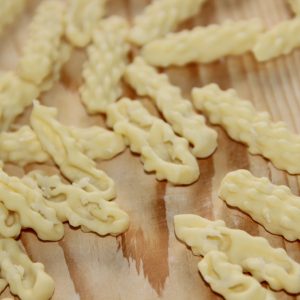
Sasanidd are typical sweets from Acerenza that look similar to dangling earrings. They consist of 3 or 4 elongated rings that are 3 to 4 centimetres in diameter and a couple of millimetres thick, that are joined together at one end. Its shape is described by some as half of a daisy flower. Another commonly found version which is much faster to make is a sort of macaroni, about 3 to 4 centimetres long and 5 to 6 millimetres thick, which has small ridges on its surface.
Uncooked sasanidd are yellow because they are made from a mix of durum wheat semolina with water. Once they are boiled in “vino cotto”, which is obtained from the reduction of grape must, they take on a red-purple colour. They have a sweet and sour taste, with a fruity, pungent, intense and fairly persistent aroma. Its consistency is reminiscent of al dente pasta. It has blisters on the outside and is slightly gelatinous.
Sasanidds are made during the grape harvest period: generally, on the day after the grapes are pressed. They can be made up to 8 days after the must has been filtered, skimmed and boiled for about 10 minutes to stop further fermentation. The process begins when black grapes which are mostly the Aglianico variety are pressed. In some families this was mixed with other local black grape varieties such as Colatammurro, Aleatico and “Pulasciam”. In the past, people crushed the grapes using their feet, inside a vat. The must then passed through a basket made from reeds and canes, into another receiving vat. Today, however, after the grapes are passed through a crusher and destemming machine, they are then crushed further by hand inside of a colander; the must obtained is filtered through a wide-weave cotton cloth and after being left to settle for the whole night, it is
then filtered further.
The filtered must is boiled in a traditional copper pot, which is called a “crangidd” or “caudaredd” depending on the size of the pot. After the foam that forms on the surface is removed, the must is then left to boil until it reduces to about half of its volume. During the reduction of the must, the durum wheat semolina, typically made from the traditional grain varieties Saragolla and Senatore Cappelli, is kneaded with slightly warm water. The dough consistency must be quite tough, due to the fact that when the dough is then shaped it is not possible to add more flour. In fact, this would lead to the formation of a sticky substance during the cooking process in the must, which would then compromise the quality of the vino cotto when it is reused to prepare other desserts. It is necessary to start with a quantity of flour that is appropriate to the amount of must available, taking into account that all of the sasanidds must be cooked at the same time in one batch.
Generally, 100g of semolina should be used per litre of must which is boiled. After making the dough the sasanidds are given their typical shape by thinning out a cylinder of dough by rolling it under the palms of your hands until a kind of thick spaghetti is formed which is a couple of millimetres thick. At this point, one end of the spaghetti is pressed between the thumb and index finger to form 3 or 4 consecutive rings which have a diameter of 3 to 4 centimetres. These are joined together at a single point. Another traditional and more common method which is faster, is to drag a cylinder of pasta about 7-8 millimetres thick and about 3 centimetres long, under your fingertips, on the back of a copper or aluminium grater or on an aluminium fork with widened prongs to obtain the characteristic ridges on the surface. It was also customary that to keep children entertained, shapes would be made, such as bracelets, stylised dolls and squares. At this point it was cooked in the vino cotto. It takes a particular skill to understand and define the exact point that the reduction of the must has become adequate enough to be classed as vino cotto which could then be used to cook the sasanidd properly. For this reason, at this point the older women of the family would have to give their input, based on their experience, as to whether the right cooking point had been reached,
based on the smell and consistency. If the sasanidds were cooked too early they would be too light in colour and too soft in texture and if they were cooked too late, they would remain hard and raw.
Once they had been cooked for 10 minutes, they would be drained using a spoon with holes in it and placed on a clay dish. They are often accompanied by quinces that are cooked in the same vino cotto that is used to cook the sasanidds. The quinces flavour the vino cotto, which once removed from the pot, can be kept for further use in the preparation of other desserts. To understand when the vino cotto is ready to be stored, it is necessary to carry out a test in a dish. The density of the liquid is observed after leaving it to cool for a short amount of time.
Generally, the amount of vino cotto obtained is about 1/5 of the initial volume of the must, with variations dependant on the variety of grape used. Sasanidds are eaten within a few days, if they are stored in a cool and dry place which is not the fridge they can last for 4 or 5 days. The production of these sweets is only linked to the town of Aceranza, which is located in the Alto Bradano area, which
is historically suited to the cultivation of grapevines and the production of wine, as well as olive trees and olive oil. This territorial vocation has meant that it is traditionally customary to prepare various products made from grapes and wine, some of which are also found in other municipalities in this area. Sasanidds prepared in this way, however, are not found in other Lucanian municipalities.
The etymological derivation of the name Sasannid is not known with certainty. Some history buffs who are originally from the area say that it comes from the name of the Greek population which inhabited the Acheruntino territory, the Sasi. This hypothesis is also based on the observation of the presence in local dialect of the saying: you are like “nu sasanidd” which is said to someone who is inept. The practice of boiling the grape must to obtain the vino cotto which is then used to prepare various other products was already used back in Roman times, however it is not known when the production of sasanidds dates back to. The local elders say that it certainly dates back to more than 150 years ago, but that is as far back as the family memory is able to go. The preparation of the sasanidds also has a social value for the people of Aceranza: traditionally this moment represented an opportunity for the family and the neighbourhood to gather, involving several generations of women and children while the men were engaged in work related to the harvest of the grapes and the preparation of the wine.
The locals boast of the exclusive presence of this product in their tradition. In fact, the same name is also used in Gravina in Puglia and Grassano in Basilicata to refer to traditional sweets that are also inked to the harvest period and vino cotto. The Gravina sasanidds however, are completely different and are much more similar to mustazzoli, and in the recipe that is commonly used today the vino cotto has been replaced by vincotto made from figs. The preparation of the Grassano sasanidds, on the other hand, has a similar dough preparation in its initial phase, but then differs in shape (doughnuts) and is cooked in vino cotto and water. The product is available in limited quantities since the preparation of the sasanidds removes must from the wine production process. For this reason, each family prepares them exclusively for their own use, reserving a small portion for neighbours and friends. There have been some recent attempts to extend their shelf life by placing them in glass jars that are then cooked later using a bain-marie, which has allowed them to be shipped.
It is necessary to safeguard this product as it is at risk of disappearing, both due to the lack of handing down the dough making techniques necessary and due to the decreasing production of wine by local families, leading to less must being produced from native grapevines.