


土扎粉
Tu zha is the name of a variety of rice noodles belonging to the Han ethnic group’s tradition. They were conceived during the Ming dynasty in Jiangxi province (Wanzai County, Yichun district, Luocheng City) almost 800 years ago. Making the noodles is a totally handmade process, without additives.
The raw material is a variety of early local rice. The first phase is the fermentation of rice which is soaked in water (20-30 cm deep) for 10-20 days in winter and 5-6 days in summer. Next, the rice is drained, rinsed to wash off impurities and finely ground. Afterward, the dough is left to rest and allow the solid and liquid parts to separate. The rice is then put in a cloth bag and drained once more.
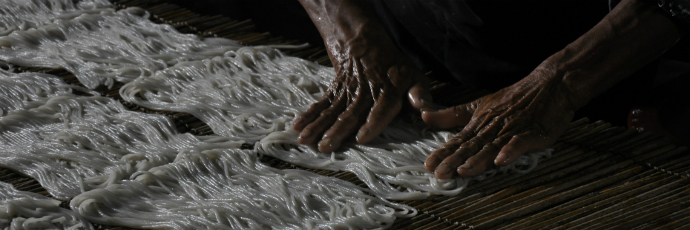
It is then placed in a wooden press which is covered with a stone to drain the remaining water out. At the end of this process, the humidity of the rice has to be between 45-50%. If lower, it may be hard to handle the dough and the noodles could break when cooking. The dough is used to form small spheres (diameter roughly 10 cm) which will then be put into hot water. When cooked, they are rinsed, massaged and then placed inside another manual press that is placed on top of the pot where the noodles will be cooked. When the water boils, the mixture is pressed to form the noodles, which fall directly inside the pot. When the noodles rise to the surface, they’re ready: after draining they are put into cold water. Next, they are placed on a bamboo mat inside a 25x15cm frame. When the noodles are cold and they have taken the shape of the frame, the frame is removed and they are left to dry in the sun. However, the noodles could break if they become too dry, thus it is important to pay close attention during the drying phase. At the end of the process (when humidity is down to 10-20%), they are tied with straw and stored in a cool and dry place.
This procedure is very complex and requires a lot of labor. It’s a production technique that can’t keep up with the pace of industrial, lower quality production. The final outcome is excellent only when traditional and early varieties of rice are used. However, their output from the manual production process is lower compared to the modern industrial varieties. In this perspective, traditional handmade noodles are at risk of disappearing from the market and it is, therefore, necessary to protect this ancient handicraft at any cost.

