Mjamaâ

Ark of taste
Back to the archive >
Mjamaâ

المجامع

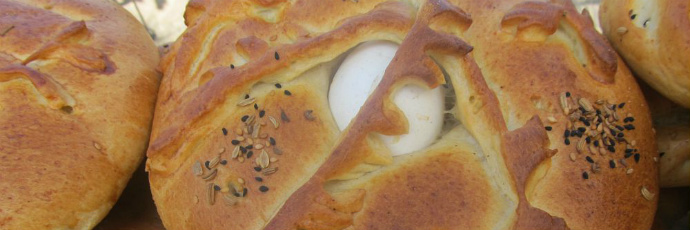
Mjamaâ, also called Khobz el Aid, is a traditional bread from the city of Le Kef, in northwestern Tunisia. The ingredients include very fine wheat semolina, olive oil, table salt and gorsa. Gorsa is a particular type of ground and sifted wheat flour. Spices and herbs (anise seeds, rosemary, thyme, rosebuds, etc.) are added to the dough. Everything is kneaded together with a bit of water, and then rested for at least 30 minutes. The dough is kneaded again until smooth, then shaped into individual portions that rest for another 30 minutes. These portions are shaped into disks and decorated with extra dough formed in braids or patterns. Optionally, the dough can be brushed with an egg wash, rested again for 30 minutes, then baked at 220°C for about 25 minutes. It is sprinkled with cool water once removed from the oven to help it cool. For the occasion of Ayde, the bread is decorated with hard-boiled eggs and served with lamb meat. Eggs can be colored with natural dyes or decorated with messages or wishes. For families, sometimes the name of the person for whom the bread is being baked is written. The bread is also prepared for parties and wedding ceremonies. Mjamaâ is sold commercially through bakeries, and still prepared by some women at home. It was once made by the female members of the family for each member of the household, but this is no longer a common practice. Bakers are the chief makers of this bread today, but many do not follow the traditional production methods, skipping some of the resting time and adding various modern or artificial ingredients that negatively affect the taste of the bread compared to the traditional version.

Back to the archive >
Le Mjamaâ, connu aussi sous le nom de Khobz el Aid, est un pain traditionnel de la ville de Le Kef, dans le nord-ouest de la Tunisie. Il est confectionné à base de semoule fine, de farine de froment (gorsa), d’huile d'olive et de sel. On peut y ajouter différentes épices et herbes (graines d’anis, romarin, thym, fleur d’oranger, boutons de rose, etc.). Le tout est pétri avec un peu d’eau et laissé au repos 30 minutes. Le pâton est ensuite de nouveau travaillé jusqu’à devenir souple, puis il est coupé en portions laissées de nouveau à reposer 30 minutes. Ces pâtons sont ensuite étalés pour former des disques et décorés de bandes de pâte croisées. La pâte peut être badigeonnée de jaune d'œuf, mise à reposer 30 minutes supplémentaires, puis cuite au four à 220°C pendant 25 minutes. Elle est ensuite aspergée d’eau froide au sortir du four pour en faciliter le refroidissement. À l’occasion de l’Aïd, le pain est servi avec de l’agneau et agrémenté d'œufs durs éventuellement colorés à l’aide de teintures naturelles ou décorés de messages. On y écrit parfois le nom de la personne à laquelle le pain est destiné. Les femmes en préparaient autrefois pour chaque membre de la famille, mais cette tradition a disparu. Le Mjamaâ est vendu dans les boulangeries et est encore préparé à la maison par certaines femmes à l’occasion des fêtes et cérémonies rituelles. Aujourd’hui, on le trouve majoritairement en boulangerie, mais nombreuses sont les recettes à ne plus suivre le mode de production traditionnel : on diminue le temps de repos ou l’on ajoute différents ingrédients modernes ou artificiels dénaturant le goût du pain, désormais très éloigné de sa version traditionnelle.

Territory

StateTunisia
Region

Le Kef

Production area:Le Kef city

Other info

Categories

Bread and baked goods

Nominated by:Abrougoui Lobna