


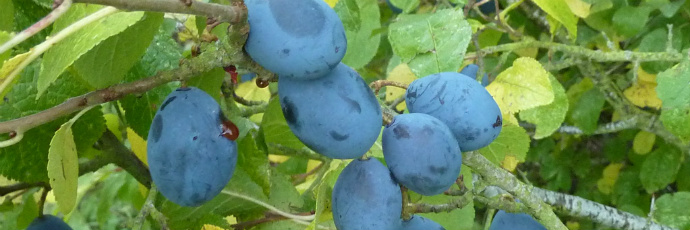
Shropshire Prune
The Shropshire prune damson (Prunus domestica insititia), a type of damson, is a subspecies of the plum, and is thought to be a hybridization of the bullace (the wild plum). The damson has a distinguished heritage, having been introduced to the UK by the Romans. The first written record of the damson in the UK dates back to 1676. The Shropshire prune damson is a small (1 cm x 1 cm) drupaceous, clingstone fruit, oval, and pointed at one end. Uncooked, its skin is dark blue to indigo, its flesh yellow-green. Cooked, the flesh transforms into a dazzling deep red. The damson tree bears magnificent white blossom in April, and the fruits, if the weather is kind, are ready for harvest from September to October. Even the appearance of the remarkable blossom is a cause for celebration in local communities. In terms of flavour, the Shropshire Prune Damson is the essence of ‘plum,’ and its versatility means it is excellent for both sweet dishes, such as jams and jellies, and savoury dishes, such as chutneys and relishes. The Shropshire prune damson is also used to make a range of distinctive alcoholic drinks such as damson wine, damson liqueur and damson gin. The Shropshire prune damson trees are a distinctive feature of the local landscape, marking the changing seasons through the gnarled form of ancient trees in winter, blossom in spring and deep purple fruits in autumn. Mixed hedgerows including the Shropshire Prune are typical of the area and provide valuable food for livestock and birds. The Shropshire prune damson was common in Shropshire, Herefordshire, Worcestershire and Montgomeryshire in orchards and as a hedgerow tree. A similar damson is also present in the Lake District where it is believed to have hybridized slightly differently to suit the local microclimate. Damsons are also associated with Kent Many Shropshire prune damson trees were planted in the 19th century to provide dye. The damson crop was sent, for example, to the Lancashire cotton mills for khaki uniforms, to Kidderminster for the carpet trade, and to Ludlow for the glove trade. There is still a strong tradition of Shropshire Prune products being made domestically in what is a distinctively rural area, where the weather can be harsh and food supplies have historically been ‘laid down’ for the winter.
Back to the archive >
