


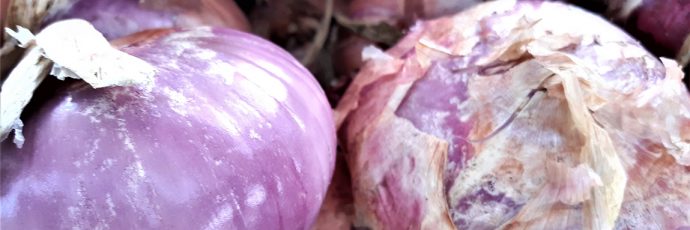
The Matera onion is much larger than those commonly available on the market. It has a purple colour that tends towards pink. It has a sweet taste and is slightly aromatic. When it is sliced, soaked and then cooked these features are accentuated greatly. It does not a have a strong and pungent smell. Its texture is crunchy but also delicate, which means that it can be eaten raw.
The Matera onion is a seasonal summer product, which, if stored correctly, can last up to a year. In the city of Matera, in fact, it was used in many traditional peasant recipes, in particular in the main dish of the town: the “cialledda”. It is a simple recipe containing nothing more than a dish of mixed raw vegetables with stale bread, that is left to soften together for about an hour. There are different versions depending on what you have at home, but tomatoes, oil, salt, oregano and onion must make up the base of it and can never be missing. Another recipe where it is used is calzone with “sponsaglio”, or onions which are ripened in spring, which are tender and fragrant. They are cooked in a pot and are the main feature of pizzas stuffed with olives, anchovies and capers.
The Matera onion grows in soils which have lots of clay and dry conditions. In order to make the bulb larger, farmers would crush the flower stalk (thallus) with their foot, so that the plant did not blossom. It was cultivated and harvested by men in the fields, but its conservation was entrusted to the women who created “serte” (braids) with the outer leaves of the onion to be able to hang and dry them in a cool and dry place, that was most importantly dark so that it would not begin budding.
This onion is still commonly consumed locally, but the standardisation of tastes has put local varieties at great risk of disappearing. It can still be found in some city markets, but it is not in high demand and the more common white, golden or red onions are preferred.

