


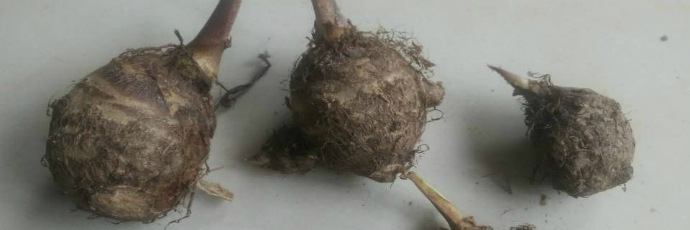
乌杆枪
The history of the cultivation of taro in China dates back thousands of years to the first centuries AD but these tubers have never been a staple daily food. Today one of the regions involved in its production is Sichuan that conserves more than 60 different taro in its germplasm bank. One of these is cultivated by farmers in the village of Dahe who preserve the seeds of a very small variety called wuganqiang.
The wuganqiang is oval in shape, and so is also referred to as egg-wuganqiang. The stem is violet-brown. It weighs around 30 grammes. It requires little water and so is very popular with farmers with limited access to this resource.
The wuganqiang is planted as a bulb in March and April along the banks of water courses where the conditions are ideal for growth: very damp and well drained soil and the absence of submersed areas. It grows in 5-6 months and harvest starts at the beginning of August in the Chinese lunar year. The stem is cut with a sickle and the tuber is dug up with a hoe.
Compared to other varieties the wuganqiang does not irritate the hands, is less likely to provoke allergic reactions and so is suitable for the elderly and the young.
It is roasted and used in soups or offered as a gift to the gods. It is easy to cook and has a pasty, glutinous and soft consistency. The wuganqiang is highly nourishing.

