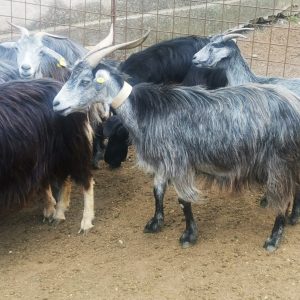
The Lucanian grey goat or Potenza goat is an indigenous breed from Basilicata, it is widespread both in the territory of Potenza and Matera, in particular in inland and marginal areas.
It is large in size: the height at the withers for females is about 70 centimetres, while for males it is 80 centimetres. Females can reach a weight of 50 kilograms, while fully grown males can weigh anywhere between 70 and 80 kilograms. The coat is either completely grey or black, with long (from 5 to over 15 centimetres) and wavy hair. The grey coat is less common than the black one. It is also possible to see the presence of black filaments on the back of grey specimens or white areas on the stomach and on the outside of the leg. Some even have a brown colour where the root of the hair emerges. They are characterised by a thin head, with medium-sized ears that are semi-sideways and forward. Both the males and females of the grey Lucanian goat breed will generally have horns, but it is possible to that some will not have them. The horns are close to the back of the head, slightly flattened laterally and diverging; they can also be rounded back. They generally have a beard and a of hair on their head. The males have very long and wide necks. They have robust limbs and large black hooves. The mammary system is moderately developed, and generally the grey strain has a larger chest.
It is a dual-purpose breed: in fact, it is good for the production of milk, but also the young goats are very valued and appreciated for their meat. It is a seasonal breed, it gives birth when there are more pastures available, starting from February. Sometimes, however, in favourable spring environmental conditions, some of the animals can give birth even in October-November. Usually, females give birth once a year but sometimes they can give birth twice in 14 months, they will also often birth twins. Kids reach a live weight of 8-10 kilograms 50-60 days after being born. The colour of the kid’s meat is particularly light. The quantity of milk produced is about 300-350 kg per lactation period, which lasts 240 days for goats who birth multiple kids. The cacioricotta which is made from the milk of these goats is highly prized and it is produced from February to the beginning of autumn.
The Potenza goat represents an example of a successful biological adaptation to a hostile environment. It is, in fact, a rustic breed that manages to use bushy pastures, stubble and woodlands, thus managing to take advantage of everything that it finds in the area in which it is found: it feeds on wild pear trees, fodder, acorns and oak. The morphological characteristics are the result of their adaptation to the territory: in fact, the long hair gives it resistance to parasites, bad weather and brambles. The attachment of the udder is also closer to its legs and not as large as it is in other breeds which also protects it from brambles. This means that, in these environmental conditions, it is able to produce more milk than other non-adapted breeds. They are capable of walking long distance and a climbing: these characteristics ensure that the Lucanian grey goat is able to transform the fodder and shrubs it feeds on in the mountains, which are in places that are inaccessible to tractors and to man, into prized proteins.
In the past, almost all of the Lucanian peasant families raised some goats. Their milk was used to feed both kids and lambs in the case that a sheep would birth twins. Both men and women took care of the goat breeding. In 1922 the veterinarian Loperfido, when speaking of the breeding practices in Matera, wrote: “Goat breeding is practiced on a large scale; this is kept with the sheep because its milk, which is much richer in water and poorer in fat, serves to dilute the sheep’s milk. There is nothing special about our goat. It belongs to a local breed, it is small, with a black, grey or mixed coat. However, black is the most common. It is found with or without horns. It gives an average of half a litre of milk per day, which is made into cheese when mixed with sheep’s milk. Like the sheep, the goat also ends up in the slaughterhouse. A good dead goat weighs about 15 kilos. The meat is eaten in September. Like the sheep, the female goat is given to the billy goat when it reaches two years old. Mating season takes place in June or July, and those that have not mated the first time, do so in September. Females give birth to one or two kids, in some rare cases even three. The first born kids are raised, the others are sold to the slaughterhouse.” (Loperfido L., Pastorizia Materana, extracted from the magazine “Allevamenti”, 10 May 1922, N. 5, Tipografa Fratelli Vena & C., Palermo, 1922, p.5).
When Potenza goat’s have a black coat, they look similar to the Gargano goat, but there are differences between the two breeds. The Potenza goat can have round and backward horns, and it also has ears that hang down. The Gargano goat has ears that are to the side and horizontal. In addition, the Gargano goat has a flat nosed face, a characteristic that is not present in the Potenza goat.
In the second half of the twentieth century the number of heads of this breed had reduced considerably, reaching just over 500 heads. Over the years, in fact, the number of breeders available to manage this type of breed has decreased, as this breed is difficult to breed because grazing in marginal areas such as woods and tree pastures, unlike that in the open field, requires staff with great experience and passion; moreover, wolves are present and if the goats are left free, they will fall prey to them. At the same time, the demand for goat meat on the market has decreased compared to that of lamb. In the last ten years, thanks to the commitment of the young breeder Canio Abbate, Assonapa’s registry was established. With the establishment of the Registry, the number of animals raised has started to increase again. So today the A.R.A. controls 3335 heads, which are distributed in 51 companies. 30 of these are in the province of Potenza and 21 are in the province of Matera. It is likely that if the subsidy that is currently given to breeders for the maintenance of this breed were increased, and if there was greater awareness of the positive characteristics of this breed, both for the ecosystem and for human health, these numbers could improve further.
Back to the archive >