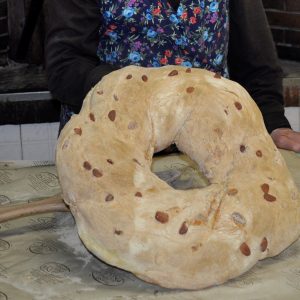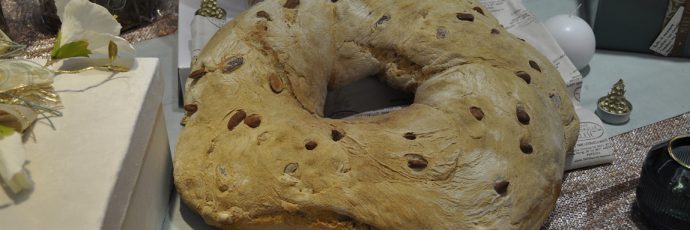
Piccilatiedd’ is a donut-shaped sweet bread that is traditionally from Potenza. Durum wheat semolina flour and water are the simple and basic ingredients that make the dough. Almonds are added to these two ingredients which give it it’s characteristic sweet flavour. Its weight can vary from about 1 to 3 kilograms. The crust is crunchy, amber coloured and opaque, it is lightly floured. The crumb is compact, and the air bubbles are medium in size and not uniform. It smells of wheat and dried fruit. The flavour tends to be sweet, and it is quite persistent. Piccilatiedd’ is kneaded by hand, sourdough is used for leavening, and it is cooked in a wood fired oven. This sweet bread will keep for over a week.
Piccilatiedd’ was the star of the dinner on Christmas Eve in Potenza. It usually accompanied other dishes such as cipollata: a poor condiment that was eaten as a soup and enriched, during the holidays, with fish such as baccalà or eel.
Bread has always been a fundamental food for Lucanian farmers and shepherds, bakeries or shops were rare in the past and hot meals too.
The ancient peasant tradition forms the solid foundation of the typical regional cuisine. Simple dishes or the so-called “poor” ingredients were, but very often still are today, a fundamental element of the Potenza area, which is characterised by mountains and rural areas with agriculture based mainly on breeding animals and the production of wheat or other products necessary for the sustenance and needs of one’s family.
In some towns there were communal ovens, that were generally on the side of houses, which were used simultaneously by several families. Since wood was scarce, it was exchanged for services or basic necessities. Each family scrupulously guarded their personal secret for the dough.
On Christmas Eve you wouldn’t “camara”, that is, you wouldn’t eat meat. People would fast at lunch and the dinner began at 6pm, at the time of Ave Maria. Sweet bread with almonds was intended for special occasions and religious holidays. Its preparation actively involved many women of the family who, as usual, gave the recipe to the youngest female member of the family. On the night of Christmas Eve it was the head of the family who, after having recited together with the other prayers of thanksgiving, would cut up the Piccilatiedd’. It was a sort of Christmas ceremony: each family member expressed their good intentions or wishes, they exchanged good wishes and the little ones kissed their father’s hand as a sign of reverence and affection. After this, the meal was started. First, a crust of bread was cut to be kept as a good omen and to be brought back to the table the following year. The Piccilatiedd’ was then cut into slices, distributed to the people who were sat at the table, which then symbolised the start of the dinner. Traditionally the set table was not cleared up until the next morning. Even today, the Christmas tables of Potenza welcome the characteristic bread with almonds to celebrate the Nativity, in memory of the local gastronomic and religious traditions.
Some families, thanks to their older members, keep the tradition alive and bring this sweet bread to the table on Christmas Eve. However, it is no longer produced at home and not many bakeries make it. The younger generations are especially at risk of losing the historical memories and the symbolic and convivial meaning of this sweet bread. They are witnesses of a peasant cuisine whose familiar oral narration is gradually fading.
Back to the archive >