


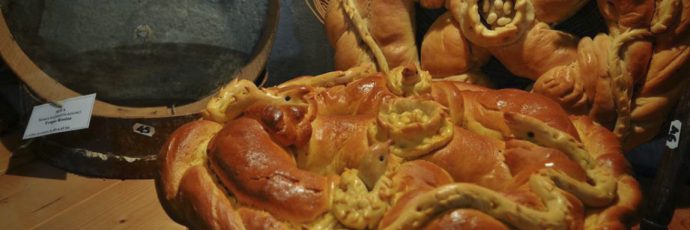
The gugliaccio or cugliaccio, whose name in Albanian dialect is kulac, is a typical dessert from the gastronomic tradition of the Albanian arbëreshë communities that is made from soft wheat flour, re-milled semolina, eggs, extra virgin olive oil, lard, yeast and wild fennel. Only a few simple ingredients are needed for this dessert, but it requires great dexterity to form the dough shapes with your hands that characterise it.
Today it is produced mainly in the locality of San Costantino Albanese (known in the Albanian language of those who have lived there for centuries as Shën Kostandini i Arbëreshëvet) a small town of 600 inhabitants in the Sarmento Valley.
It has been made since the 16th century. It was prepared and packaged by the groom’s relatives on the Thursday before the wedding which was officiated according to the Greek-Byzantine ceremony of the Orthodox Church. According to tradition, two “gugliaccio” must be prepared for each ceremony, one decorated and the other plain. The plain one has a circular shape and represents the intertwining of the four arms of the couple and the everlasting bond of marriage.
The decorated one, on the other hand, has a nest in the centre that represents the new home of the couple. The eggs inside, which are always present in odd numbers, are a symbol of good luck and fertility.
The two birds initially represent the in-laws protecting the house from adversity and the two snakes represent the sadness of the spouses for their parents that they are about to leave. According to this symbolism after the eggs have hatched, they are then transformed into the birds, which now represents the new couple and that must defend themselves from snakes, the symbol of evil and adversity that will hinder the couple.
Snakes represent the pitfalls but also the experience of a new form of life, as the individual transformations that each lover must have to undergo to welcome their loved one into their life. The eyes of these symbolic animals are made with pepper.
The simple gugliaccio was placed under the decorated one. During the ceremony, the decorated one was offered to the priest who, after having dipped it in wine, offered it first to the bride and then to the groom as a sign of mutual belonging.
The arbëreshë are communities of Albanian origin that descended from the Balkan populations who, starting from the fifteenth century, in different waves and following the death of the Albanian national hero Scanderbeg and the consequent Ottoman occupation, emigrated to the ancient Kingdom of the Two Sicilies. Today the arbëreshë communities are widespread in almost all of the southern regions, especially in Calabria and Basilicata, and represent one of the most numerous ethnic-linguistic minorities in Italy.
In Basilicata they are found mainly in Vulture: in Barile, Ginestra and Maschito and at the foot of Mount Pollino, in San Paolo Albanese and San Costantino Albanese. Over the centuries, in Vulture, the original culture has evolved in a slow process of assimilation by the indigenous populations, remaining alive, for the most part, only through language; in San Costantino and San Paolo, on the other hand, strong conservative elements have ensured that the cultural identity remained intact not only in the linguistic aspect, but also in the traditions and customs.
The marriage, celebrated using the Greek Byzantine ceremony, still takes place in the ancient language of the arbëreshë. It represents a rite of passage, a change that will take place within the small community, the families involved, and above all in the life of the spouses.
During the coronation of the spouses (i.e., marriage) the kulac becomes food, the Eucharist: it is offered by the relatives of the groom, to sanctify the union of the two spouses in front of the whole community, in place of bread.
The gugliaccio is the symbol and visual representation of the marriage ceremony that is taking place; the passage of the two young people to their new social status; the juxtaposition and alliance of the two families; and the compensation paid by the groom’s family, through the offer of the gift to the bride’s family. According to tradition, in fact, the spouses will go to reside with the husband’s relatives.
In the small town of San Costantino Albanese this ancient marriage ceremony and, consequently, this product was at risk of being lost by the new generations. The gugliaccio was recovered about thirty years ago by Nunzia Larocca, a baker who managed to save the recipe by collecting the stories of the older women of the village.
Today the gugliaccio is a certified product with the Pollino Park brand, made according to a production specification and it is also certified.

