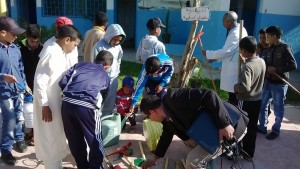
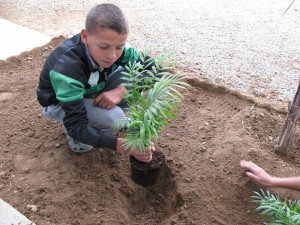
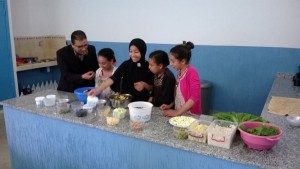
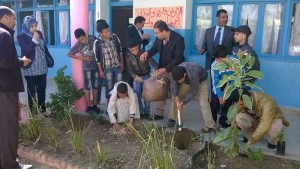
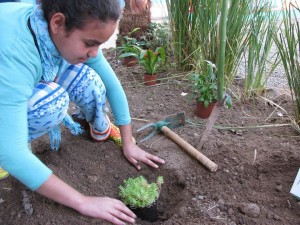
This 350 m2 Slow Food garden is found in the Zear region, in the newly created Madinat Al Firdaous, a city located between Rabat and Tamesna. Al Firdaouss is an Arabic term that means ‘heaven’ or ‘paradise’. The school currently has 235 students, a director and seven teachers. Some of the students here come from rural communities, and for them agriculture is an ever-present reality in their daily lives, while others come from the city and thus have nearly no contact with the earth. The school also hosts an association dedicated to nature and ecological citizenship that is incredibly active, directed by a passionate and exciting professor, Mr. Brahim, who enjoyed a childhood among the fields and trees. “For a long time”, he tells us, “man thought that his development had no consequences and that it posed no threat to the environment, since nature is able to reestablish a fundamental balance and therefore, in the end, each generation would inherit unspoiled resources. Today we know that our lifestyles have negative effects on nature. My parents prepared me for the life of a farmer, but the changes in modern life go incredibly deep and it is our duty to guide the new generations”. Mr. Brahim, who has more than 40 students (both boys and girls), proposes a dynamic vision that invites the kids to act for the safeguarding of the environment. One of the school’s students, Jamila, explains that “the garden offers the opportunity to apply lessons and practical knowledge that we have acquired in the classroom: math, literature and biology”. A member of the parents’ association, Kamal, adds that “it also promotes food self-sufficiency”. The garden is managed according to a calendar that was established upon its creation. The students are responsible for all of the gardening: they are there to learn about environmental and food education. Almasjid school garden applies traditional gardening techniques: the use of manure, composting, mixed cropping and plant rotation, waste collection management and association of the trees with the crops (as there are a few fruit trees in the garden). It is also very important to cover the ground with mulch in order to conserve the water in the soil; indeed, covering the ground (with either straw or grass clippings) not only limits evaporation from the soil, but it also enriches the hummus. What’s more, working the top soil improves the circulation of water all the way to the plants’ roots. When organizing a garden it is important to remember that some plants require a great deal of water, such as cantaloupe, artichokes, watermelon, cabbage, celery and lettuce. On the other hand there are some vegetables (onions, shallots, asparagus, potatoes, garlic and sweet potatoes) that require drier conditions. The Almasjid garden is cultivated with local varieties; the seeds and plants are bought directly from small scale farmers weekly at the bazaar or brought directly from the students’ homes. Some of the crops currently cultivated are: eggplant, green peppers, radishes, tomatoes, zucchini, cabbage and cucumbers. There are also spices and medicinal plants in the garden, like mint, oregano, celery, lavender and thyme, which are useful in fighting off pests. There are also other natural methods in use to keep pests away, like a solution of alcohol and soap, a tobacco infusion, and insecticides made from garlic, oil and soap. The garden’s produce is used to prepare some of the food in the school’s cafeteria, thus achieving the principle of food that arrives “from the fields to the table”.
Area
Madinat Al Firdaous, Zear region
Coordinator
Younes Zghari