


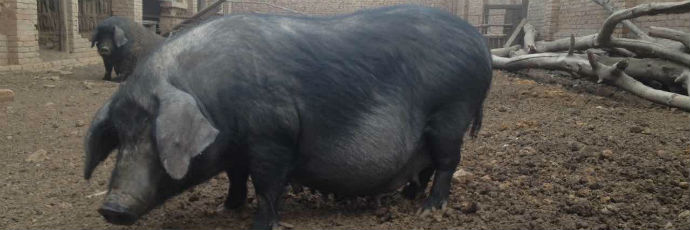
小伙猪
Xiaohuo pigs are small-sized, and compact; they measure ca. 45 cm shoulder height and can reach up to 80 kg in weight. They have a small and light head, with ears that fall onto the snout, which is covered in thick bristles and has few wrinkles. The hindquarter is thick, short and flat, the belly droops slightly and their skin is thin. Pigs of this breed are sexually precocious and very fertile. One of the characteristics they are most known for is vivaciousness: it is the reason why the name of these pigs is the same term used to describe little children. Additionally, it is very tame. The meat is good, of a red color, tender, has little humidity and is marbled.
Xiaohuo are the small-sized pigs of the ba mei breed; the other two typologies are “daba mei” (large-sized) and “erba mei” (medium-sized).
In the past, these three typologies all had the same name: “pigs with big ears”. The current name, ba mei, dates back to 1979 when a convention of four provinces (Shaanxi, Gansu, Ningxia e Qinghai) was held and it was decided to describe local pig breeds based on their common characteristics. Among these required characteristics is also a particular fold on the forehead, the shape of which resembles the upside down Chinese character “八”. Then it was subdivided into three typologies, based on size.
Now only 300 xiaohuo sows are left, reared in the conservation center of the experimental farm of the Agricultural School of Shaanxi. The goal of this center is to save local breeds and the cultures they represent.
Most of the breeding facilities (80%) are in the Shaanxi, Gansu and Ningxia Provinces, especially in the areas around the river Jing in Shaanxi and the Guanzhong plain. They are slaughtered in the provinces of Gansu and Ningxia. Xiaohuo pork is not sold on markets yet: Numbers are still very low and all efforts are concentrated on reproduction in order to ensure its survival.
Like in other cases, the reason for the drastic reduction of this breed is connected to the introduction of foreign breeds and the markets, which demands pigs that grow quicker with lower breeding costs, as well as the lack of effort to control and protect autochthonous biodiversity by the government.
This breed has a long history, demonstrated by a historical recipe of the Shaanxi from 1000 years ago, for which the use of xiaohuo meat is indispensable. The recipe is the “Shaanxi pork juice”, created in a period of war during the Northern Song Dynasty (960-1279 a.C.). In those times it was important to feed the warriors but also to preserve the meat.
The ingredients to this dish, which is also a method of preservation, are xiaohuo pork, red clay from Jiu Zong mountain, water (an old scripture recommends getting it by “melting snow in the month of December according to the lunar calendar”), bean powder and a spice mix (powdered ginger, fennel, pepper, cinnamon and cloves).
The first phase consists in washing the meat, cutting it into pieces of 1-3 kg each and cooking it in a casserole with the spices for 2-3 hours. After the meat is taken out of the pot, the juice left inside is left to cool down and solidify. The fat will rise to the top while the remaining pieces of meat deposit on the bottom of the pot.
The superficial fat and residual meat are taken away and only the lighter part between these two layers is kept. The resulting gelatin is then mixed with red clay, carefully sifted beforehand so ensure only the fine dust is used, and some bean flour is added. This mass is then formed into small balls, similar to soy beans (ca. 1 cm in diameter), which are left to dry in an aerated place. After they are placed in ceramic recipients with a tightly fitting lid, which can be sealed with beeswax for longer conservation. Like this, the meat can be stored for years. When needed, one of the balls can be dissolved in water or barley soup and used to cook meat. Thanks to this rehydrated sauce, the result will be a flavorful dish or soup, tasting as if it was made to order.

