


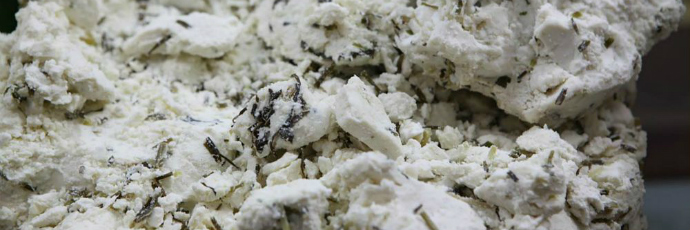
Van Otlu peyniri
Van herbed cheese is made in the Van province of eastern border of Turkey from sheep’s milk, occasionally sup
plemented with cow’s milk. Themost popular of these cheeses is Otlu, is mainly produced in small dairies. The herbs such as wild garlic added to the cheese increase both its taste and nutritional value. Twenty-five different wild herbs, including multiple varieties of alliums, thyme, wildflowers and more, used in the cheese production are naturally grown in pastures of the Van region. It has been said that the addition of the herbs was a technique brought to Turkey in the 18th century by a doctor from Iran. Back then this cheese was also used as a medicine. Otlu cheese is produced in spring when sheep and cattle graze on the local wild herbs that grow in abundance in pastures. First, the raw milk is heated to 30°C and natural rennet is added. After one to two hours, the curd is placed in a cotton bag and mixed with herbs that have been soaked in brine, giving the cheese a sharp, salty taste. The bag is pressed between two heavy stones or heavy wooden weights and left to drain. After 5 – 6 hours, the cheese is cut into 2 – 3 cm. slices, salted and transferred into brine. The cheese sits in brine for some days and then preserved in tin or plastic containers. It is left to age in a cold place until early autumn. An alternative method is dry salting, in which salt is spread on the Otlu cheese, and cheese pieces are put into clay jars or plastic containers. They are covered with salt to prevent contact whit the air, and vine leaves or mud seal the jars. Under this method, Otlu is aged at 7 – 8° C for three months. Typically, the final product is square, white or yellowish in color and is known as semi-hard cheese. Otlu cheese has a salty flavor and a noticeable aroma of thyme. Van Otlu cheese is one of the most well known of traditional Turkish cheeses, and is widely consumed in southeastern Anatolia. Currently, fewer livestock farmers and expansion of industrial dairies threaten the future of traditional Van.
Back to the archive >
