


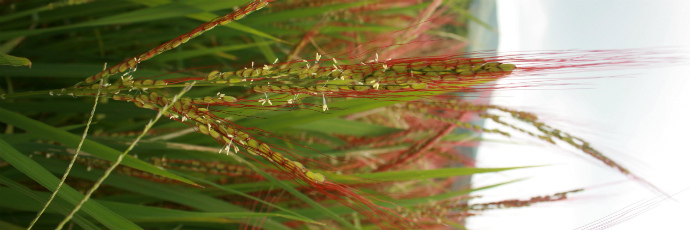
Tsushima-Akagome
Tsushima-Akagome is an ancient breed of rice (Oryza sativa) native to Japan. It is specifically grown on an island in the Nagasaki Prefecture called Tsushima, which is north of the Kyushu region. Being geographically close to the Korean Peninsula, these islands have historically been a place of interaction between the Eurasian Continent and Japan. As such Tsushima has played a very important role in the country’s history as a window unto cultural and economic exchange. For many years Tsushima-Akagome rice has been used in Shinto rituals. Traditionally the grains were packed into straw bags and hung from the ceiling of farmers’ houses as offerings to the gods. It is said to have originated between 500B.C. and 300A.D. during the Yayoi-period. No selective breeding has been made since this time and the modern strain is still considered to be fairly similar to the ancient species. A high level of tannin from the seed imparts a reddish brown hue upon both the ear and the grain but as the rice gets polished this color lightens considerably. It is fairly resilient to the elements and capable of defending itself against an array of insects and diseases. Being adaptable to climatic changes make it an appealing crop to grow, especially in conjunction with its high nutritional value. Despite the fact that cultivation is initially quite easy, yields tend to remain low as the stalks are susceptible to breakage because they grow to be exceptionally tall.The method of production today is basically the same as those used for more conventional breeds of rice but it is essential that no chemical fertilizer be applied and that pesticides or herbicides are avoided to the greatest extent. In recent decades there were up to 15 people still producing this unique strain but over time the number of producers has decreased and there is currently only one person involved in its production. In order to ensure this crop is protected from extinction it is necessary to boost awareness of it and increase the number of people who cultivate it.
Back to the archive >
