


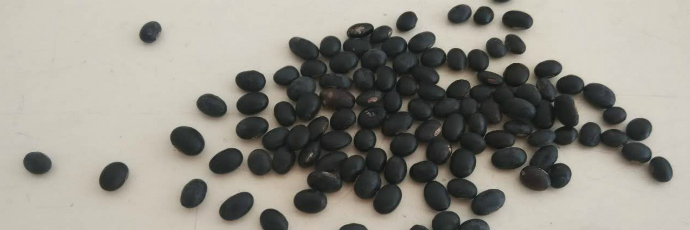
天等黑豆
The black bean of Tiandeng (the name means: ""wait for the rainy days to have a good meal every day"") is also called the ""small black bean"" because of its size and colour or the ""horse bean"" (as it was also used for horse feed). It may also be referred to as ""the black pearl that grows on the rocks"" (as there are many rocks in the fields of the Prefecture of Tiandeng and the beans appear to be pearls on these rocks).
It is oval, rounded and a little flat. It has a yellow mark on one side and a clear and oval cavity. The skin is fine and fragile, it has two straw-coloured cotyledons and an oily texture.
It is rather hard and delicate.
The seeds have been conserved and passed down by local farmers for generations. They are planted during the 6-8 days in which the wheat comes to maturity. Deep 4-5 cm furrows are hoed in the ground and 3-5 seeds are placed around every 30 cm. They are covered in earth using a hoe. They seeds can also be sown by hoe, digging holes of equal depth at the same distance. Weeding take place on two occasions, before flowering and after September. When the stem is 50-60 cm, the shoots must be wrapped onto the branch to ensure that they grow again without producing beans.
The stems must be monitored to ensure that they are 70-80 cm long. Depending on their growth the beans may be fertilised with manure, whilst a little ash is always added to the soil.
Hand harvest takes place in October when the leaves fall and the stems dry. The branches are bended by hand or with a sickle to detach the pods. The roots are left in the soil to function as a natural fertiliser. The pods are left to dry in the sun on a sloping surface, and moved by stick from time to time. The pods are then removed and the beans collected.
Black beans are mainly used to make tofu, with an intense aroma and soft consistency.
This variety of bean has been conserved since time immemorial but is now at risk as local farmers plant improved yellow-seeded varieties.

