


The Striguny onion is a product connected to the village of Striguny in the region of Belgorod in eastern Russia. It is one of the oldest local varieties, and its use is universal. The bulb of the onion has a round shape. Its skin is golden colored. It is a variety that keeps well. The bulbs can be stored perfectly for all of winter, and the onions can be cultivated starting from seeds or from bulbs. Its taste is spicy, and thanks to a high percentage of solid matter, it can be preserved in jars or dried. The village of Striguny, near Russia’s border with Ukraine, is famous for its onion, even far outside the village boundaries. The farmers of the village of Striguny began to cultivate it on their farms at the beginning of the 17th century. The onion was sold at local markets and in the markets of the southern provinces. It was seeded over 240 desjatine (an old Russian unit of measure), which today would be about 260 hectares, and up to 3300 tons were harvested per year. At its peak, about 6000 tons were harvested annually. The inhabitants of the village say that during the rule of Peter I of Russia, a man had seen how the onions were cultivated in the south, and realized it was a convenient trade because it did not require much land and the yield was high. After this, his fellow villagers went to these distant places to recover the seeds, but they only managed to bring home two buckets, divided into a very small quantity per person. From then on, the farmers of the village became experts in their cultivation. In 2009, an onion museum opened in Striguny. Each year there is an onion festival where visitors and locals can freely taste different dishes made with the local onions. Despite its history and local importance, today, only about 50 tons of Striguny onions are sold each year. Now, they are grown mainly for local consumption and are marketed directly by the growers at local farmers markets.
Back to the archive >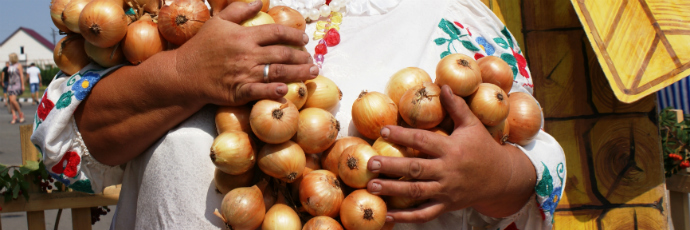
 Students of the Gastronomic Sciences at Pollenzo are collaborating with Slow Food to fill the Ark.
