


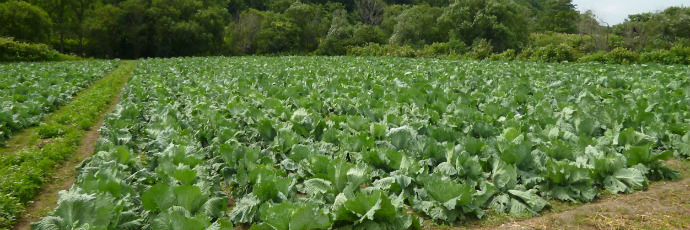
The Sapporo Taikyu cabbage is a late season variety that grows quite large. One head can weight 8-20 km and be 40-50 cm in diameter and oblate in shape. It is a high yielding but rare variety. Sapporo Taikyu is an essential ingredient used in preparing typical preserved foods of Hokkaido, such as nishin-zuke (pickled herring), and salmon or sandfish izushi (fish pickled with rice and vegetables). With its natural sweet taste and its thick leaves, it is an ideal cabbage variety for pickling, as the leaf shape and crunchiness withstand the pickling process. Also, as it is uniquely sweet and juicy, it is also good for making many other dishes such as ohitashi (blanched vegetable), cabbage rolls, salmon chan chan yaki (grilled salmon with vegetables) and okonomiyaki (pancake mixed with variety of ingredients with flour and vegetables).
Sapporo Taikyu cabbage was first introduced and grown in Hokkaido (the northern island of Japan) before spreading to the south of Japan. The name of this cabbage appeared for the first time in an official record when the cabbage seeds were brought from the United States by the Hokkaido Development Commission and test grown on farms in the beginning of Meiji period (1868-1912), but it is also assumed that it had already been cultivated in the southern part of Hokkaido before the Meiji period. It is believed to have been created from a cross of other cabbage varieties, developed for its long shelf life and ability to be processed.
Because of Hokkaido’s short growing season of just six months (from April to October). The Sapporo Taikyu cabbage was an important food source. This cabbage was part of the everyday diet, and also used by fishermen on long deep-sea fishing voyages. Because of its large size, it can withstand the harsh wind, snow and low temperatures, and even when the outer cabbage leaves are frozen, the inner edible portion can stay intact and edible. As not many vegetables are available in the wintertime in Hokkaido, it became popular as a vegetable that can be preserved as pickles. It was once a common sight in Hokkaido to see these cabbages and pickles for sale during the months of October and November, and they can still be found in local markets in season. Sapporo Taikyu cabbage production peaked in Showa period in around 1935. However, many elderly growers have stopped growing because each head is heavy, the workload is more than a regular sized cabbage. In addition, it requires more strength to cut the stem when it snows at the time of harvesting
Until the 1930s, the Sapporo Taikyu cabbage was the dominant local variety grown on over 1000 hectares, but since the 1950s, its cultivation has decreased dramatically as it was overtaken by the newly introduced hybrid varieties. In 2007 in the Atsuta district, there were about fifteen Sapporo Taikyu cabbage growers, but by 2013 only five growers remained. In other areas of Hokkaido, it is reported that two growers remained in Hidaka-cho Monbetsu region and one grower in Niikappu-cho, but overall, it is only estimated to be around few others more. In 2013, Sapporo Taikyu cabbage was grown over just 3.2 hectares, yielding 210 tons in these three regions of Hokkaido.
Back to the archive >
