


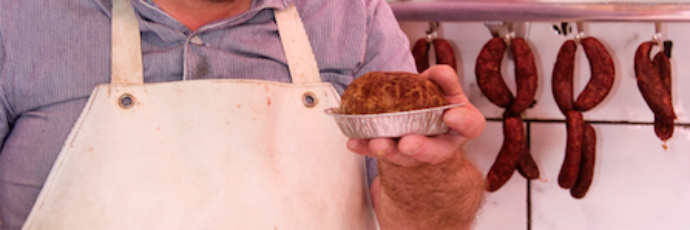
Ostheimer Leberkäs
During the French-German War in France, a butcher from Ostheim vor der Rhön (whose name is unknown) discovered the French specialty Pâté de Campagne. In 1870, returning to Germany, he developed the recipe for this meat terrine based on his recollections of the French specialty. His recipe remained unvaried and today is possible to find it only in few butcher’s shops in Ostheim. As in the French original, the Ostheimer Leberkäs is eaten cold. Although this product was once referred to as a terrine, this term was relatively unknown in Germany and therefore the producers adopted a term used in the southern regions of the country, ‘Leberkäs’. Leberkäs typically refers to a sort of meat pie, usually eaten hot, and produced with minced pork and beef meat, lard and (outside Bavaria) around 5% liver. Unlike Ostheimer Leberkäs, the product known more commonly in Germany as Leberkäs contains several exotic spices, such as ginger. Ostheimer Leberkäs is prepared with fresh meat right after slaughter. The pigs used to make this pâté are reared in small farms around the region and, although there is no specific breed linked to the production of this product, the more commonly used breed is Deutsches Landschwein. The breed originated from the original native pig with infusions of German Landrace and Danish Landrace. The breed is found primarily in the southern, eastern and northern parts of the country. Dutch Landrace have the same general appearance of the other Landrace breeds, being white in color and having the characteristic large and drooped ears. The breed has been developed to have wider backs and heavier hams than found on some Landrace strains. The breed is also known for its high fertility and very good maternal abilities. To make the loaf, fresh pork is minced to a medium-large grind, in order to confer a desirable chewiness to the final product. 90% of the dough is pork lean and fat meat from various parts of the pig (muscles, bacon and back) and especially the cheek, while the remaining 10% is liver. The meat used in the Ostheimer Leberkäs is seasoned only with salt, pepper and nutmeg. The dough is then wrapped in Schweinenetz (caul fat) and baked. Once out of the oven and cooled, the outside has a crisp surface and the inside is reddish-brown in color. It is shaped in different sizes (it comes in packages weighing 375 g, 750 g, and 10,000 g mainly for use in the butcher shop to cut slides) and forms, it can be square or round. The taste is intense but not strong, with a delicate note of liver. Any addition of chemical additive is forbidden, save for colouring agents used to make the meat look more red (e.g.: sodium nitrate). It is now produced in the city of Ostheim vor der Rhön and outlying suburbs.
Image: © Stefan Abtmeyer
Back to the archive >
