


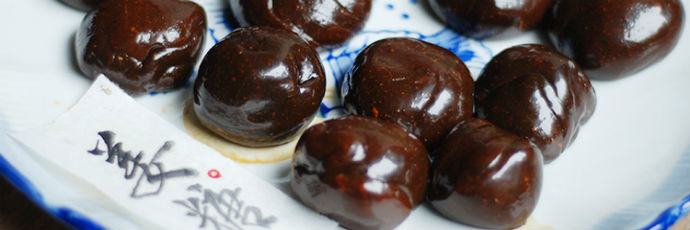
客家黑豆姜糖
The Hakka are an extremely ancient Chinese ethnic group, a subgroup of the larger Han. They share the same language and common ancestors, rather than a specific geographic presence. Apparently, they originally come from the areas along the Yellow river (the current provinces of Shanxi, Henan and Hubei) in northern China. From there, they migrated to southern China and the rest of the world.
The Hakka language is written with special characters, which are different from those of common Chinese.
The Hakka women were hard workers and used to resume work in the fields two months after giving birth. To get strong and recover as soon as possible, the ancient Hakka had invented special energizing candies, made with black sugar and ginger.
The production of the Hakka black sugar and ginger candies dates back to the times of the Ming and Qing dynasties, about 3000 years ago. It is a cultural heritage that has survived over the centuries and is still preserved by the inhabitants of the Hakka village of Zhixi, in Fujian.
Traditionally, each family grew its own ginger plant, fertilizing the soil with the manure of their own animals. Most plants were grown on sandy soils in the mountains: they were planted in spring and harvested in winter.
According to the recipe, after the harvest the ginger roots are dried and cut into thin slices, and finally ground to obtain a powder. Locally produced cane sugar is added, along with vegetable oil and black soy bean powder. The mixture is boiled over a wood fire, until it becomes thick and viscous. This is then molded into 2 centimeter small balls.
The candies are dark brown and the ginger scent is very intense.
The Hakka women eat them not only to boost their energy, but also to treat dysmenorrhea, increase the production of milk, facilitate recovery after a bleeding, ease rheumatic and arthritic pains.
They are eaten as they are or added to pork or chicken stews, or boiled in water.
The production of candies in Zhixi is still a strictly artesanal process: their quality depends entirely on the know-how related to the preparation of the ingredients and the ability to handle them. Unfortunately, less and less people know this traditional technique,

