


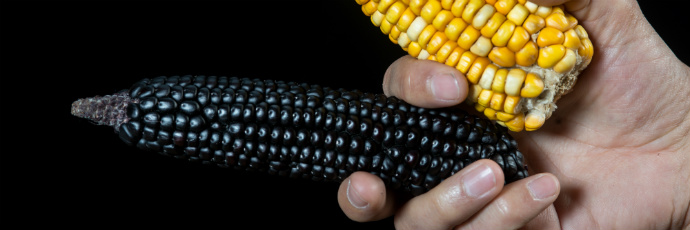
There are still nine indigenous groups living in the Caribbean region of Colombia: the Chimila, Wayuu, Kogi, Arzario, Arhuaco, Yukpa, Zenú, Kuna, and Emberá. Along with some farming and afrodescendant communities, they have made corn their livelihood up to the present day, preserving 27 varieties. The most important varieties for the market are yellow and white corn, and the cariaco variety, which they still sow and sell widely along the Atlantic Coast.
Cariaco amarillo (yellow cariaco) is the most commonly used variety. The plants grow to over 2 meters and produce up to 3 medium-sized cobs, each 10-18 centimeters thick. Combined with other crops, such as cassava, beans, and yam, corn yields 600-1,500 kilograms per hectare and its high yield guarantees it a high price. It is resistant to pests, wind, and weeds. The kernels are large, round, soft and floury, and opaque yellow in color. The plant has reddish spots, while the husk and cob are white.
Families grow it for their own consumption and they also sell it at local markets. Intermediaries buy it to sell in Sincelejo or Montería. This corn is important for the food sovereignty of the Zenú people, who have traditionally preserved it. The Zenú use cariaco corn to make a traditional drink known as chocolate. It is also used to make almojábanas and pancakes or chicha de masato, which is used as a traditional drink to “christen” new homes and to celebrate carga de casa rituals, celebrations for when an indigenous authority is chosen, when a woman is asked for her hand in marriage, and in novena prayers for the deceased.
Back to the archive >El maíz amarillo es el que más se utiliza. Su plantas verdes crecen más de 2 m. y producen hasta 3 mazorcas medianas y gruesas de 10-18 cm. En asocio con otros cultivos como yuca, frijol y ñame produce de 600 a 1.500 kg por hectárea y su buen rendimiento le asegura un precio alto. Es resistente a plagas, vientos y malezas. Los granos son grandes, redondeados, blandos y harinosos de color amarillo opaco. La planta tiene pintas rojizas, el cascarón y la tuza son blancos.
Las familias lo cultivan para su autoconsumo y lo venden también en mercados locales. Hay intermediarios que lo compran para venderlo en Sincelejo o Montería. Este maíz es importante para la soberanía alimentaria de la etnia zenú quienes lo han conservado ancestralmente.
Los indígenos zenú utilizan el maíz cariaco para producir una bebida tradicional denominada “chocolate”. También es utilizado para la elaboración de almojábanas y arepas o chicha de masato, que se utiliza como bebida tradicional para “bautizar” las casas nuevas y celebrar las cargas de casa o vivienda, festejos para cuando se elige una autoridad indígena, cuando se pide la mano de una mujer para contraer matrimonio, y en novenarios de muertos.


