


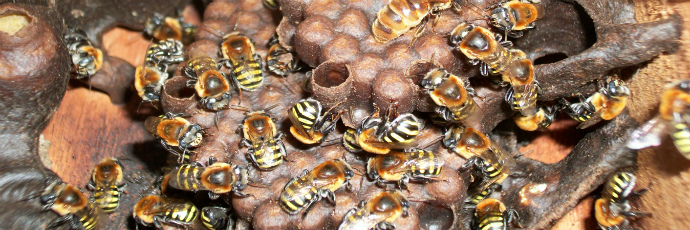
Mapa
The indigenous Wayuu communities of northern Colombia extract honey from the hives of a species of bee called Cargo Barro or Canálila (called Mapa in the local language). These stingless bees are native throughout La Guajira, Colombia. They are small, with bodies measuring approximately 12 to 20 millimeters, and they have light yellow stripes on their abdomen. They belong to the family Apidae, which are bees that are characterized by having a pollen basket on the lower part of their legs in which they can carry mud or pollen. Another defining characteristic is that they build their honeycomb with the mud they carry on their legs back to the hive, hence the name Carga Barro (“mud carrier”), which is used in Southern and Middle Guajira. In Upper Guajira, the bee is known as Canálila. The honey of the Carga Barro bee is multifloral and is made from three types of flowers in the forests of Guajira: trupillo, dividivi and guamacho. The trees do not usually blossom at the same time, and a pollen analysis can be carried out to determine the predominant percentage of pollen and the kind of flower, and even occasionally to obtain monofloral honey. Production levels vary depending on the time of year. Production is greater in January, February and March, as more trees are in blossom because it is the rainy season. The honey can be found in June and July, but in smaller quantities. In total the hives of this species of bee product between 100 g and 500 g of honey per year. This honey has a relatively high level of moisture (25-30%), and it is therefore at risk of fermenting quickly. It has a sweet flavor, pale color and a very light texture. The Carga Barro bee builds its hives vertically in small cavities in the trunks of hollow trees. They are very passive bees, which is why the species is at risk of extinction, as when they are attacked they do not flee or vigorously defend themselves, and their queen can easily be killed while the other bees in the hive abandon the nest and migrate elsewhere. Similarly, the bees’ natural habitat has also been affect by the felling of trupillo (Prosopis juliflora) trees, in which they usually make their nests. The indigenous Wayuu people used to hunt for honey in hives in the grooves of trees. In order to extract the honey, they would use unsophisticated methods, such as burning the trunks to drive out these passive bees with smoke, leaving the nest badly damaged beyond repair, causing the bees to die. Sometimes, they caused forest fires when the fire could not be controlled because of strong winds. This hunting was causing native to bees to go extinct as they died in their hives. This practice has changed over time because of the severe consequences it had for the survival of this species and the environmental damage it caused. Now indigenous people are using new methods to continue exploiting this rich food resource. Once the hive has been located, the part of the tree it is in is cut away and then taken to the Rancherías (Wayuu communities). There the honeycomb is removed and the indigenous people make a groove in the part where the honey is stored, which is like a kind of storage area. The honey flows out into a container and the honeycomb is not destroyed. This is a simpler way of extracting the honey and the bees do not die. Another method they have introduced is to use pumpkins or cannonball fruit so that the bees make their hives inside. When it is time to harvest the honey, one of the ends of the pumpkin is broken off and the honey extracted. Indigenous people believe that the honey has medicinal properties and use it mainly to treat eye disorders. They generally apply a drop of Carga Barro honey to the affected eyes for complaints such as conjunctivitis, itching and burning. It is also used to treat sores that develop in children’s mouths after they have a high fever. The honey harvested is used only locally, and is not sold commercially. Though there is now more attention paid to safeguarding this bee, population levels are much lower than they were in the past. The area has also seen negative effects of climate change, and furthermore, there are increasingly fewer communities that engage in this beekeeping or honey collecting activity, as the knowledge of handling bees and harvesting honey has been lost.
Back to the archive >

