


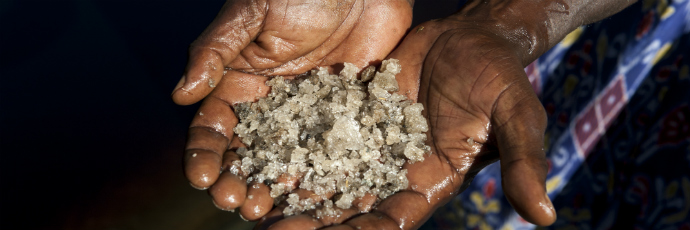
The inactive volcano of El Sod is found in the southern part of Ethiopia, and its name means “the house of salt.” The crater contains a black lake that in its dark and slimy depths hides a deposit of raw salt crystals. Salt harvesting varies by season, and the best moment to harvest is at the end of the rainy season, from December to January. The water evaporates, the level of the lake is lower, and the salt crystallized on the bottom of the crater is extracted using water to separate it from the black mud that covers it. The crystals are crushed using a stone as a pestle on another stone or wooden surface before finally being dried in the sun. The producers distinguish three different types of salt according to quality, with the best, called ilkole in the local language, being used in cooking and occasionally for animals.
A legend tells that Boke crater was found by an ox a thousand years ago. After tasting the salt form the crater, the ox became physically different from all of the rest of the oxen in the herd. The shepherd noticed this and followed the ox to find Boke crater. Borana herders have used Boke crater’s salt for both animal and human consumption ever since.
The sun-dried, black salt is packaged and sold in 50 kg or 100 kg sacks by the 63 producers that are joined in a local cooperative. The salt is sold unlabeled, and remains unknown outside of the Borana area and neighboring towns and ethnic groups. As the small pond at the center of the crater where the salt is extracted is fairly deep, the extraction process requires very experienced people who can dive under the water to dig up the muddy salt, a very difficult task. There is only one cooperative with experience in extracting the highest quality salt at the right time. Most of the cooperative members are men, and they created the cooperative four years ago to safeguard the crater area and in order to enhance the sustainable use of this salt.
Image: © Paola Viesi
Back to the archive >
