


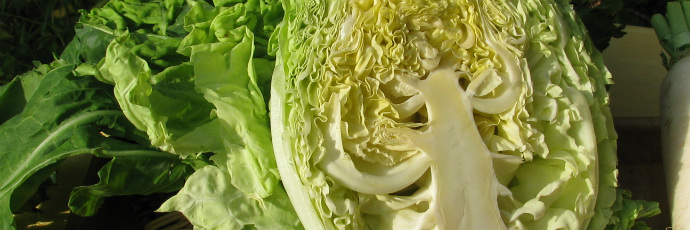
Bamberger Spitzwirsing
The Bamberger Spitzwirsing (Brassica oleracea L. convar. capitata (L.) AELF. var. sabauda D.C.), also known by the shorter name Bamberger Wirsing, is a variety of Savoy cabbage. Upon becoming aware of the existence of this Savoy variety, thanks to recent research into the vegetable varieties of the gardening town of Bamberg in 2010, experts began work on a more precise categorization of the headed cabbage that takes its special properties into account, and which may lead to a dedicated botanical name. This old local variety is listed as Bamberger Wirsing in the “Rote Liste der gefährdeten einheimischen Nutzpflanzen in Deutschland” (Red list of endangered indigenous crops in Germany), in the June 2010 version issued by the German Agriculture and Nutrition Office.
It is praised for its tender and mild flavor, with a delicacy unusual of cabbage. Bamberger Spitzwirsing is characterized by a large, loose head with a longitudinally oval shape that can range from purely elliptical (blunt pointed) to egg and heart shapes (pointed). The leaves are far less crinkled, and far more tender than those of round head cabbages. It requires only half the cooking time of other Savoy cabbages and can thus be cooked gently, allowing it to retain its delicate flavors in virtually any dish. The particularly fine quality that the literature has generally attributed to Bamberger Wirsing as well as all other Bamberg produce varieties since around 1800 is perhaps due to the unusual natural growing conditions of the Bamberg basin and the highly developed skills of Bamberg’s gardeners that have been documented since the early 14th century.
Bamberger Spitzwirsing is a product of the nearly 700-year horticultural tradition of Bamberg (located in northern Bavaria) that has remained an element of the townspeople’s sense of identity to the present day. It remains an essential component of Bamberg’s traditional vegetable-oriented cuisine, and the towns gardens make up one-third of the historical center and UNESCO’s “Town of Bamberg” World Heritage Site. The cabbage-growing region also encompasses all of the present urban area of Bamberg, as well as that of the neighboring town of Hallstadt, including its Dörfleins district.
Bamberger Spitzwirsing has always been a star of the horticultural tradition that has been a key element of Bamberg’s identity in the eyes of its residents and outsiders for centuries. It, and other remaining local vegetable varieties, are increasingly becoming focal points of this heritage. As is customary in Franconia, cabbage is an indispensable companion of roast duck and goose; in Bamberg it is also served alongside roast veal and loin of veal with kidneys, as well as pork. However, the limited cultivation and sales geographically limited to the cultivation area are not enough to guarantee the variety’s long-term survival. The consumption and cultivation of savoy, which ranks far behind white and red cabbage in popularity, has been in decline in Germany for years. This trend has also affected Bamberger Spitzwirsing in its market niche. Its fan base in Bamberg is shrinking because fewer and fewer people cook for themselves, and traditional Franconian regional cuisine.
The Bamberger Spitzwirsing is not well adapted to commercial sale or transport. It has a relatively short storage life, is bulky and easily damaged (it develops black bruises if pressed too firmly), and despite its large volume, it weighs relatively little – yet it is sold by weight. Gardeners that transitioned from direct marketing to selling their produce to wholesalers in the second half of the 20th century abandoned the Bamberger Switzwirsing to cultivate compact, round-headed cabbage instead. In 2012, this variety was grown on just 7.5 hectares of land. Today, Bamberger Spitzwirsing can be purchased in the farm shops of Bamberg gardeners, on the Bamberg weekly market, and occasionally in vegetable shops and in supermarkets in the Bamberg town area. If it were to be promoted regionally and beyond, it could quickly become a favorite of gourmets and others thanks to its outstanding flavor.
Back to the archive >
