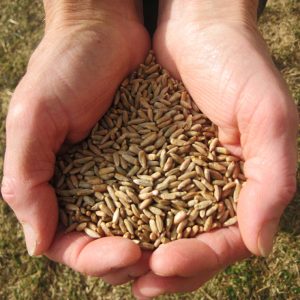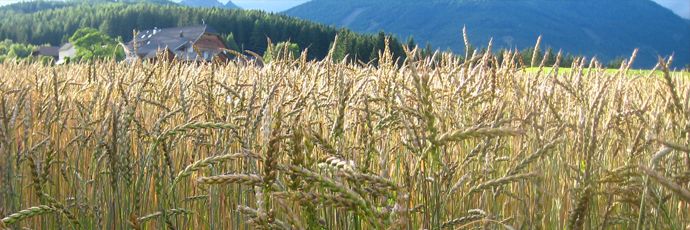
Lungauer Tauernroggen is an old variety of winter rye originating from the Lungau region – the southernmost region of Salzburg. It’s cultivation in the region dates back at least 300 years and it was considered to be the variety best suited to the harsh, cold climate of mountain areas and was grown at an altitude between 1000 and 1500 meters above sea level. In the 1920s it was added to the Register for Plant Varieties for Cultivation.
Tauernroggen rye was cultivated until the 1970s when the rapid decline in grain cultivation in the mountains saw it vanish almost completely. Recently, a group of farmers decided to recover this important piece of local biodiversity. Thankfully a handful of local farmers had continued producing the grain on small plots for their own self-sufficiency, and the variety wasn’t lost for ever.
The rye is sown in October and prefers heavy to light but not sandy soils.
The seedlings are planted prior to the winter, as they need to be frozen in order to be strong for the spring and summer when they produce a high stalk of around two meters.
The pyramid-shaped ear has green to yellow-green kernels.
The harvest takes place in August, after which the rye is dried and cleaned. The smaller grains are separated and used as fodder for animals, and the remaining grain is ground to make rye-flour in the course of the year.
The flour is used to bake sourdough bread as well as Hasenöhrl (dough fried in lard, literally means "rabbit ears") and distilled schnapps.
Production area
Lungau region, province of Salzburg
Presidium supported by
Ferienregion Lungau, Salzburger Land Tourismus
Fam. Hötzer
tel. +43 64748164
trimmingerhof@aon.at
Fam. Löcker
tel. +43 64762970
sauschneider@sbg.at
Fam. Naynar
tel. +43 6483219
hiasnhof@aon.at
Fam. Prodinger
tel. +43 64738269