


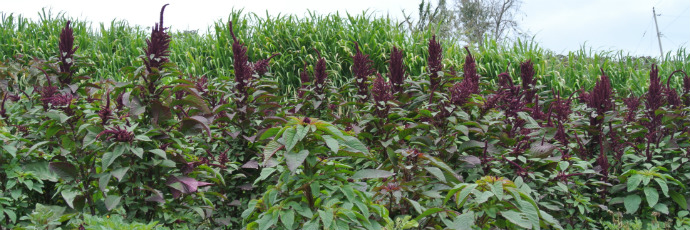
Yana ataco
Sangorache is the local name for Amaranthus quitensis. Among the Quechua people it is known as yana ataco. It is a broadleaf plant with violet, orange, red and gold flowers. In Ecuador, this crop is found throughout the inter-Andean corridor, especially in the provinces of Imbabura, Pichincha, Cotopaxi, Tungurahua and Azuay. In many communities amaranth is found planted alone, with tomato plants or sometimes with corn and beans. Six months after seeding, the plant can be harvested. One of the most important harvests coincides with the festival celebrating the deceased in November. In the Andean region, amaranth or sangorache is used in the preparation of colada morada, a traditional ceremonial drink consumed during the Day of the Dead in early November. It is also routinely used in the preparation of horchata, which is an aromatic, reddish water that also contains lemon balm, lemon verbena, horsetail, zhuyo, plantain, white mallow, among other flowers. Sangorache has a high quantity and quality of protein, in addition to phosphorus, calcium and vitamin C. It is recommended for patients with diabetes because it helps stabilize glucose levels in the body. Also, its cooked leaves are used to combat stomach acidity. Indigenous and mestizo communities of the central highlands consume amaranth in the form of drinks or beverages after childbirth and as a purgative. In some areas, sangorache cooked with beets is eaten in order to combat anemia. It is believed that sangorache in this area dates back over 5,000 years, and has been an important part of ritual ceremonies throughout history. Cieza de León described sangorache in his 16th century tour of what is now the city of Quito. Another Spaniard, Juan de Velasco mentioned it in his writings from the 18th century. The plants survived a purge by Spanish conquerors because they were not as used as food, but as a beverage and medicine. In later colonial times, the consumption and production of this product was prohibited because it was associated with rituals and ‘pagan’ ceremonies. The consumption of many of these grains and native products became considered food of the ‘Indians,’ and gradually sangorache disappeared from regular household use. Because of its important cultural and dietary properties, there is renewed interest in sangorache as a crop in Ecuador. Some chefs consider it to be ‘vegetable caviar,’ for its intense glossy black color and texture it has at first bite. It can be found in local markets in the production areas, and some larger markets in major cities. Production for home consumption still exists in some indigenous communities and rural areas, but because these producers are not connected, it is unknown how much is grown in this context. The black grain had almost disappeared from the market because of the difficulty in obtaining the flower heads. Many producers and consumers are only aware of the use of the whole flowers to produce the colada morada, and unaware of the use of the grain.
Back to the archive >
