


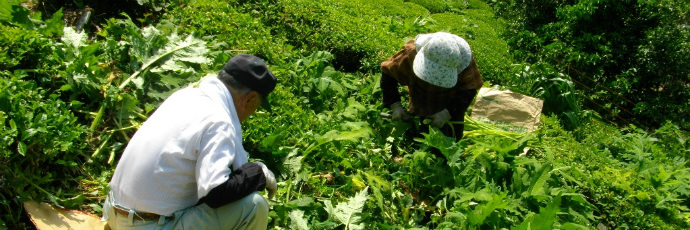
Ibigawa sawa-azami
Sawa-azami (Cirsium yezoense Makino), called marsh thistle in English, is a wild vegetable that grows in forests from northern Kinki to Southern Hokkaido. It is usually used as a medicinal herb in Japan. However, in Ibigawa (formerly the village of Kasuga), in the Mie Prefecture in southern Japan, sawa-azami is planted in fields and used as a vegetable. The plants can grow up to 2 m tall, and in spring features clusters of large (30 cm by 50-60 cm) edible leaves. In autumn, the sawa-azami plants produce pinkish colored flowers. People living in the former village of Kasuga selected wild sawa-azami and developed a local ecotype during the Tokugawa Era, more than 150 years ago. It was originally cultivated by charcoal-makers working in the steep mountains. These workers established huts to live in while working, and began to grow sawa-azami around their huts as a food source. The oudl bring the seedlings with them when returning home. Since then, the local variety of sawa-azami has been continually planted and eaten in the area of the old village of Kasuga, now part of the town of Ibigawa, saving seeds for future plantings. The thistles are grown extensively, without pesticides and using a natural fertilizer of oil cakes (abura-kasu). Sawa-azami is traditionally prepared by cooking the leafstalks with dried herring (migaki-nishin) or in miso soup. It can also be prepared by pickling, simmered in water (mizuni) or simmered in soy sauce and mirin or rice wine (tsukudani). It is eaten as an early summer season vegetable, but salt pickled versions can be preserved and consumed throughout the year. This differs from other areas of Japan, where other thistle varieties are mainly eaten in the forms of the rhizome or fresh leaves. In 2013, there were 31 documented households growing sawa-azami in the Ibigawa area, producing a total of 3650 kg. 23 of the 31 households, however, produce fewer than 100 kg per year for commercial sale, indicating a small-scale production. Growers also cultivate the plant for personal or family consumption. The crop has typically been gown in one corner of a plot dedicated otherwise to tea cultivation, or otherwise unused agricultural land. Local people have long cherished and cultivated sawa-azami, and as food it stands as a valuable testament to the mountain way of life. In 1996, the Kasuga Sawa-azami Club was formed to promote this vegetable. However, members of the club and the growers of the plant are mainly elderly, and their production levels are decreasing. This means recipes using the unique local preparations of the sawa-azami are also being lost among younger generations. The steep terrain in the area is difficult to cultivate and means there are limited plots suitable for growing crops, and tealeaves have become the main crop in the area.
Back to the archive >
