


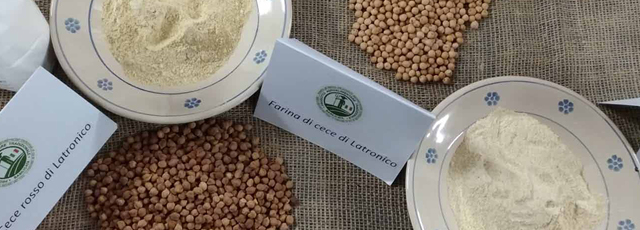
The Latronico tondino chickpea (Cicer arietinum l.) is small and round and has beige skin. The weight of a single chickpea is about 0.3 grams.
It is consumed whole or as a flour and used in various traditional recipes such as “tapparedd e cicir”, a version of fresh homemade pasta similar to orecchiette that is served with chickpeas and “panzarott chi cicir”, which are sweet fried calzoncelli filled with chickpea puree, cocoa and cinnamon. Historically they were also used in a recipe that is no longer in use: “cicir u tufo”, a recipe where the chickpeas were fried after being soaked for 15 days in water with pieces of tuff (volcanic rock). Thanks to its versatility, it is also used in modern recipes and reinterpretations of traditional ones. Latronico is a small village which has about 4500 inhabitants, located in the province of Potenza and at the foot of Mount Alpi, at about 850 metres above sea level. The cultivation of the Latronico tondino chickpea takes place at altitudes ranging from 700 to 1000 metres above sea level. The ideal environment to grow them is warm/humid and they require little water. They are planted between March and April, and harvested between August and September. The plants are harvested whole and then left to dry, it is only later that the manual removal from the pod takes place. The chickpea is then kept in cool, dry places and is eaten all year round. The name “Latronico” has Greek origins and means “hidden place”. Over the years evidence has been found of the presence of a community dating back to Enotria, and among various texts there is also reference to the cultivation and consumption of chickpeas in this community. Thanks to some historical-anthropological research related to the Brigand phenomenon and from the stories of the elderly of the town, it has emerged that in the area of Latronico, there were numerous fields of chickpeas that were used by the Brigands to obtain flour that was ground in a mill along the Sinni riverbank. It seems that this story is at the origin of the name of “ribelle” which is attributed to the Latronico tondino chickpea, which it is most famous for, and which refers to the ability to re-emerge despite adversity. There is further evidence as to the importance that the chickpea holds and what it represents in this area. There are popular sayings such as “non saps ten nu cicir mmucc” which translates to “you don’t know how to hold a chickpea in your mouth”.
Over the years the tondino chickpea was almost lost completely. The recovery of the ancient seed took place through the ALSIA Pollino bank, which had found that it was still being planted by some elderly farmers. After this discovery the recovery project of the “Custodi del cece di Latronico” was launched, in which agricultural entrepreneurs, as well as retirees and housewives in the area took part, to increase production and restore life to this product, by planting it on their own land.
Back to the archive >
