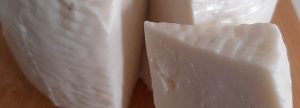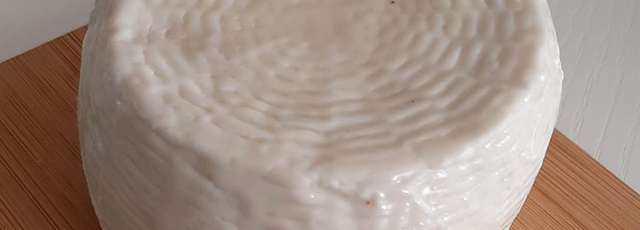
Cacioricotta is a cheese that is derived from goat’s milk. In the past, in the Basilicata region, it was obtained exclusively from the native breed of the Lucanian grey goat (or Potenza goat). It has a cylindrical shape with flat edges and rippled marks on its surface, a typical sign of the use of a “fuscella” (a cheese basket) which gives it its shape. It is small-medium in size with a height of 5-10 centimetres and a diameter of 10-15 centimetres. Its weight ranges from 500 grams to a maximum of 1kilogram. It has an ivory white colour, and a soft and compact consistency. It does not have any holes when it is eaten fresh, after about 20 days of maturation. After 2-3 months of maturation, it becomes dry, scaly and almost chalky, with very fine uniform holes. Matured cacioricotta is used grated. It has a predominately savoury flavour that is a little bit sour and delicate when fresh and slightly spicy when aged. Traditionally it is grated on homemade pasta that is made with a tomato sauce.
Cacioricotta is produced all through the hilly and mountainous areas of the Basilicata region, which is characterised by bushy pastures, short grass and woodlands, particularly suited to the breeding of the Potenza goat. A rustic breed that has adapted well to the most inaccessible areas of the Lucanian Apennines. Currently there is also a cacioricotta made from a mixture of sheep and goat milk, but traditionally in mixed farms the production of cacioricotta only became dominant over pecorino after the sheep went dry during the hot period of the year. The Lucanian grey goats are milked from February to the beginning of autumn, meaning that the production of Lucanian goat cacioricotta begins in the first weeks of spring and ends when summer is over. Due to the farming method used, the aromatic characteristics of the cacioricotta change according to the territories.
The production technique used to make cacioricotta is very particular, because it is somewhat similar to the one used to make ricotta (thermal coagulation) and also similar to the one used to make cheese (rennet coagulation). This is where it gets its name from.
After milking and properly filtering the milk, it is transferred in to the “caccavo” (a tin lined copper boiler) and heated until it boils. The milk is then left to cool until it reaches about 35oC. At this point a paste made from baby goat rennet is added. After 30-40 minutes the milk coagulates and the curd is broken using a “ruotolo”, a tool used to break the curd into the size of grains of rice. It is left to rest and then the mass is transferred into reed moulds – which are often made in plastic nowadays – where it is pressed by hand to facilitate the release of the whey from the mould. It is then left in the mould at room temperature until the next day. After this it is removed from the mould and dry salted with fine salt. The form of cheese is then moved to be dried on shelves in cool rooms. This particular method of production ensures that the cacioricotta contains not only caseins but also albumins, which is the whey protein that is normally present in ricotta but not in regular cheeses. The final product is in fact particularly rich in proteins.
Cacioricotta has very ancient origins. During the Roman era and throughout the Middle Ages, farming was essentially transhumant. Sheep were almost exclusively raised because wool was a fundamental product in the economic and commercial systems of these distant centuries. Cows were used for work in the fields, while goats hides were used exclusively to “make tents for soldiers or sails for who sail in misery” (Lucio Giunio Moderato Colimella). The mixed milk cheeses produced during Roman times were therefore predominantly made using sheep’s milk. Then in the Middle Ages, the swamps were filled which provided plains that were cultivated. This provided enough food for large animals such as cows. The middle and especially the south of Italy perfected the transhumant system. Large flocks of sheep moved from the mountains to the plains, while goats were either raised in small herds on permanent farms or again in small herds that would move with the transhumant flocks. The dominant processing technique used was still that of pecorino, a hard cheese, because the milk was mixed. In the South however, a very specific technique was born, which was unknown until a few decades ago by the Northern regions of Italy: cacioricotta. Normally the flocks went up to the mountains at the end of May, after the lambs were sold, and the sheep were towards the end of their lactation period. The journey up to the mountains took a month and the sheep could not be milked on the way or have their milk transformed into cheese. However, the goats and all the sheep that were not good at producing wool were left in the plains, so that the tax for wool producing sheep could be avoided. The lactation period of the goats is longer and could last for the entire summer. Due to the summer heat and the lack of shelter and equipment in the plains, it was impossible to use the pecorino technique to make cheese. Hence a technique which brought the milk almost to the boil was used. This allowed for the bacterial load to be reduced and ricotta to be made, a cheese that wasn’t the most popular in summer. Thanks to this processing technique, cacioricotta hardens in a few days and can be easily stored. In addition to the shepherds of the transhumant farms, it was the women who often transformed the goat’s milk into cacioricotta at small permanent family farms.
There is not a large quantity of cacioricotta available on the market, and it is even more rare to find it made solely from goat’s milk, especially made as it was traditionally from the Lucanian grey goat. To date, there is only one farm that is authorised to have a dairy in the Lucanian territory.
Back to the archive >