Slow Food
  • Donate
  • Join us
  • Italian
  • English
Slow Food Foundation

Search

  • Home
  • About us
    • What is the Foundation?
  • What We Do
    • Slow Food Gardens in Africa
    • Slow Food Presidia
    • Ark of Taste
    • Slow Food Cooks’ Alliance
    • Earth Markets
    • What is the Narrative Label?
  • Get involved
    • Why Support Us
    • Italian Slow Food Presidia Sponsors
  • Multimedia
    • Publications
    • Video
    • Gallery
    • News archive
    • Photo archive
  • Contacts
Slow Food Foundation Slow Food Foundation
  • Home
  • About us
    • What is the Foundation?
  • What We Do
    • Slow Food Gardens in Africa
    • Slow Food Presidia
    • Ark of Taste
    • Slow Food Cooks’ Alliance
    • Earth Markets
    • What is the Narrative Label?
  • Get involved
    • Why Support Us
    • Italian Slow Food Presidia Sponsors
  • Multimedia
    • Publications
    • Video
    • Gallery
    • News archive
    • Photo archive
  • Contacts

Search

Home » 10.000 Orti in Africa » Xifaki Family Garden

Xifaki Family Garden

Back to the archive >

South Africa

Limpopo

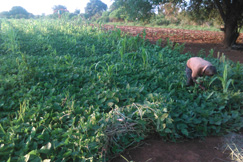
Xifaki community garden, situated 500 meters from Hanyani Thomo High School, is a 10 hectare farm cultivated by 10 family members. It operates in the fertile land along a riverbank.
The garden is partitioned into two plots, the first of which is used for cultivating winter crops while the second plot is for summer crop cultivation.
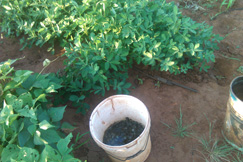
Crops cultivated in the garden include, among the winter crops: spinach, butternut squash, onions, cabbage, green beans, carrots, beetroots and tomatoes.
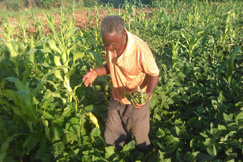
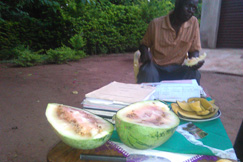
Summer crops include: corn, pumpkins, peanuts, legumes, watermelon, baby marrow, squash and Tindluwa (which looks like and is planted in the same way as peanuts, but can only be eaten when cooked, and is mainly used in some indigenous special dishes such as Tihove and Xiendlahivomu).
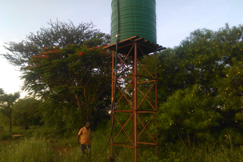
The members are taking organic compost making training through agro-ecology. They have also fixed the fence and installed irrigation drips in the garden.
They sell their surplus to local communities and local supermarkets in Giyani Town.

Area
Thomo village, Giyani, Limpopo province.

Coordinator
Ephraim Hlungwani
Products

  • Spinach
  • Onion
  • Cabbage
  • Carrot
  • Beetroot
  • Tomato
  • Maize
  • Peanut
  • Watermelon
  • Courgette
  • Bambara groudnut
  • Pumpkin (C. maxima)
  • Bean

Slow Food in South Africa

In the “Rainbow Nation,” indigenous ethnic groups—the Zulu, Xhosa, Venda and Tsonga to name just a few—have over the centuries been joined by Portuguese, British and Dutch colonizers, then subsequently by waves of Asian immigration. South Africa has the highest number of people of Indian descent outside of India in the world. Hundreds of languages are spoken across the many diverse environments, from the temperate and Mediterranean-like West Cape to the arid Karoo and the subtropical northeast. But the country’s spectacular biodiversity is being destroyed by human activity. Agricultural biodiversity, for example, has been drastically reduced due to the widespread use of GMO seeds. Around 80% of the maize being cultivated is genetically modified. This type of agriculture is linked to the similarly industrialized production of foods high in sugar, salt, fat, additives and refined flour, creating eating habits that are leading to a rapid increase in heart disease and obesity. For these reasons, the Slow Food network in South Africa is working to highlight the relationship between food and health. Awareness is being raised among consumers about the importance of eating local, seasonal food, and the Slow Meat campaign is promoting more responsible meat consumption, with lower quantities, higher quality and the use of different cuts to avoid waste. It is not just consumers who are in need of better information. South Africa also has many small-scale farming families with little basic knowledge who urgently need technical training in order to help them develop sustainable agriculture practices. The 10,000 Gardens in Africa project is therefore of particular importance to the country’s development and the health of its people.

Garden Informations

Type:Community Garden
Surface in m2:100000
Coordinator:Africa Mauhayisi Mthombeni
Sibling with:Eataly, Italy

Photos

Subscribe to the newsletter

Slow Food gratefully acknowledges funding support from European Union. The contents of this website are the sole responsibility of Slow Food and the CINEA is not responsible for any use that may be made of the information contained therein.
Slow Food - P.IVA 02743970044 - Privacy Policy - Cookie Policy - All rights reserved
Powered by Blulab