Slow Food
  • Donate
  • Join us
  • Italian
  • English
Slow Food Foundation

Search

  • Home
  • About us
    • What is the Foundation?
  • What We Do
    • Slow Food Gardens in Africa
    • Slow Food Presidia
    • Ark of Taste
    • Slow Food Cooks’ Alliance
    • Earth Markets
    • What is the Narrative Label?
  • Get involved
    • Why Support Us
    • Italian Slow Food Presidia Sponsors
  • Multimedia
    • Publications
    • Video
    • Gallery
    • News archive
    • Photo archive
  • Contacts
Slow Food Foundation Slow Food Foundation
  • Home
  • About us
    • What is the Foundation?
  • What We Do
    • Slow Food Gardens in Africa
    • Slow Food Presidia
    • Ark of Taste
    • Slow Food Cooks’ Alliance
    • Earth Markets
    • What is the Narrative Label?
  • Get involved
    • Why Support Us
    • Italian Slow Food Presidia Sponsors
  • Multimedia
    • Publications
    • Video
    • Gallery
    • News archive
    • Photo archive
  • Contacts

Search

Home » 10.000 Orti in Africa » Sakoincé B School Garden, Kokologho

Sakoincé B School Garden, Kokologho

Back to the archive >

Burkina Faso

Centre Ouest

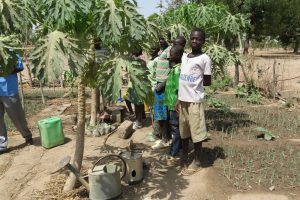
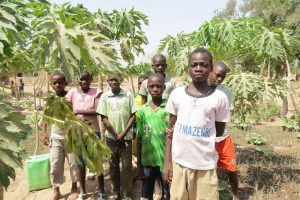
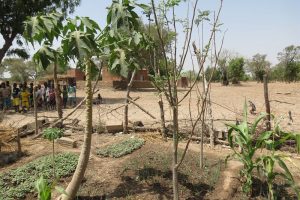
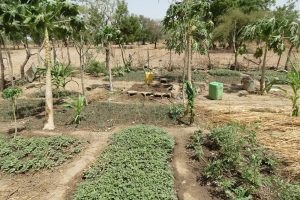
The Sakoincé B school is found in the village of the same name, in the Kokologho department of the Centre-Ouest region of Burkina Faso. A 300 square meter plot of land has been set up in the school’s courtyard to teach the students about cultivating the land. A well was dug directly in the garden to assure an adequate supply of water for the crops. Sakoincé B has seven classes, with seven professors, for more than 400 students aged between six and fifteen years old. The older students are those most responsible for the garden’s upkeep.
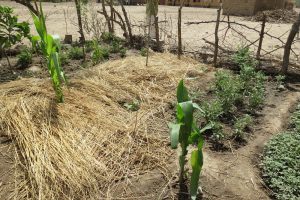
In this rather humid region of Burkina Faso, where the rainy season is quite long, market crops are the main products grown in the garden. Thus there are fruit trees, like red date, tamarind, baobab, papaya and moringas, but the garden also has onions, sorrel, beans, zucchini and tomatoes. These crops are planted during the dry season, while during the rainy season, which corresponds to the students’ vacation, the garden is dedicated to the production of corn and beans for the community.
The produce is mainly cooked and eaten in the school cafeteria, but when the production is particularly abundant a part is distributed to the locals or sold in local markets. The association of the students’ parents manages this aspect of the garden.
The students are gradually learning about organic methods of gardening, thanks to training sessions set up by the school on issues like compost production and the production of natural insecticides.

Area
Sakoincé Village, Kokologho Department, Centre-Ouest Region

Coordinator
Jean Marie Koalga
Slow Food in Burkina Faso

Burkina Faso is characterized by a rich cultural diversity, with over 60 different ethnic groups and languages. Half of this landlocked West African country has an arid, Sahelian climate. Desertification and drought are some of its most serious problems, but there are many initiatives working towards integrated local development. As far back as 1987, President Thomas Sankara proposed reforming agriculture through the application of agroecological techniques in order to guarantee food sovereignty and the country’s independence. “Let’s produce in Africa, manufacture in Africa, and consume in Africa,” he famously said. “Let’s produce what we need and consume what we produce instead of importing goods.” The Slow Food network has had a presence here since 2004. Many agroecological school and community food gardens have been developed in different regions. The gardens have made it possible to develop the network and to start the important tasks of mapping traditional foods and dishes, identifying Presidia and supporting the food communities in the promotion of their unique, high-quality products. The first West African Terra Madre gathering was organized in Ouagadougou in February 2017, allowing the local network to join together and share their experiences with traditional foods, gastronomy and knowledge. This laid the foundations for the creation of an even stronger network, which now includes communities, associations and local authorities. Currently the network is focusing on involving cooks and chefs and identifying restaurants serving local food that is good, clean and fair.

Garden Informations

Type:School Garden
Surface in m2:300
People involved:80
Slow Food Convivium:Kokologho Convivium
Coordinator:Koudbi Emmanuel Ramdé
Sibling with:Multidistretto Leo 108 Italy

Photos

Subscribe to the newsletter

Slow Food gratefully acknowledges funding support from European Union. The contents of this website are the sole responsibility of Slow Food and the CINEA is not responsible for any use that may be made of the information contained therein.
Slow Food - P.IVA 02743970044 - Privacy Policy - Cookie Policy - All rights reserved
Powered by Blulab