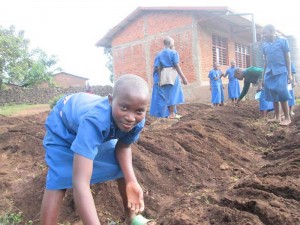
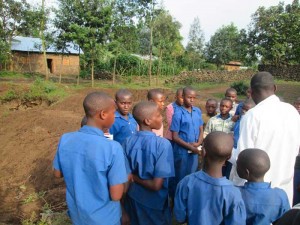
This 60m2 school garden is found in the Cyuve Sector, in the Musanze District in the country’s north. The group of students who cultivates the garden has about 650 people and 11 teachers, but those who are most involved are part of a small agricultural club with 30 students ranging in age from 10 to 12 years old. The garden is managed by the school through the teacher who acts as the group’s leader.
The garden is situated in the valley next to the school, which is a public elementary school. The plot of land that the school cultivates also belongs to the state. The soil in this region is loamy and access to water is not difficult.
The Rugeshi school garden was established in January 2014 thanks to the school’s initiative and the Slow Food Ruhengeri convivium, which noticed that the land was not being exploited and the children were not being taught about gardens. The school was then contacted by Slow Food through the same convivium in June 2014.
The garden also acts as an educational tool, as it is often used by the teachers to illustrate different parts of their lessons. Thus the garden serves to teach about biology, explaining the different types of plants and how they reproduce.
The crops are rotated in and out, and for the moment some of the different one cultivated include: eggplant, onions, cabbage, carrots, and potatoes.
The soil is fertilized with organic manure that they bring from their homes.
Finally, a part of the harvest is sold, the revenues from which are used to finance some of the school’s small expenses for extra-curricular activities.
Area
Cyuve Sector, Musanze district, northern province
Coordinator
Prosper Uwiragiye