Slow Food
  • Donate
  • Join us
  • Italian
  • English
Slow Food Foundation

Search

  • Home
  • About us
    • What is the Foundation?
  • What We Do
    • Slow Food Gardens in Africa
    • Slow Food Presidia
    • Ark of Taste
    • Slow Food Cooks’ Alliance
    • Earth Markets
    • What is the Narrative Label?
  • Get involved
    • Why Support Us
    • Italian Slow Food Presidia Sponsors
  • Multimedia
    • Publications
    • Video
    • Gallery
    • News archive
    • Photo archive
  • Contacts
Slow Food Foundation Slow Food Foundation
  • Home
  • About us
    • What is the Foundation?
  • What We Do
    • Slow Food Gardens in Africa
    • Slow Food Presidia
    • Ark of Taste
    • Slow Food Cooks’ Alliance
    • Earth Markets
    • What is the Narrative Label?
  • Get involved
    • Why Support Us
    • Italian Slow Food Presidia Sponsors
  • Multimedia
    • Publications
    • Video
    • Gallery
    • News archive
    • Photo archive
  • Contacts

Search

Home » 10.000 Orti in Africa » Nkosi Memorial School Garden

Nkosi Memorial School Garden

Back to the archive >

Uganda

Mukono

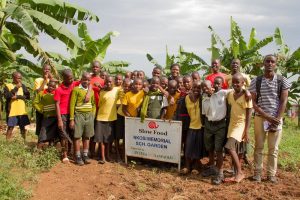
This school garden is located on the Mukono-Kayunga road in the village of Lukojjo in Nama sub-county, Mukono district. The garden measures 465 m2, with half of it divided into small, well-designed plots. A total of 23 pupils and two teachers care for the garden, with 8 boys and 15 girls.

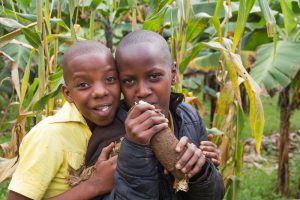
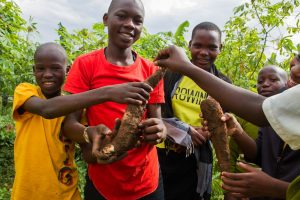
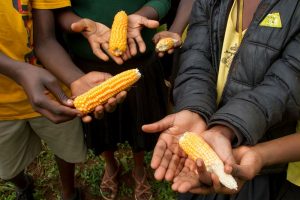
The crops grown include maize, bananas, “balugu “(climbing yams) and onions. The produce is shared and consumed by the children, teachers and parents.
Drip irrigation is used to water the crops, even during the dry season; the school management ensures that there is some water available to support the crops in the garden. The garden participants have been mainly depending on mulch and green manure but after the training they attended, they hope to start preparing compost to improve the garden’s soil fertility. During the holidays when there are no students to manage the garden, the school management plans to find a caretaker for the garden to ensure that activities can continue when the students return from the holidays.

The seeds planted in the garden are brought to the school by the participating students and teachers from their homes and they plan to save their own seeds in the future. More training and learning opportunities are needed at the school especially on soil fertility management, pest and disease management using local resources and extracts, produce management and post-harvest handling as well as general garden management.

The school management plans to adopt the use of natural pest control measures like repellent crops, traps and natural plant extracts so as to stop dependence on synthetic chemicals, used in the previous seasons.

Area
Lukojjo Village, Nama sub-county, Mukono district

Coordinator
Ruth Nassiwa
Slow Food in Uganda

Slow Food has been actively supporting the food communities in Uganda since 2006, working with many young volunteers and regional coordinators, creating Presidia and organizing agricultural activities as part of the 10,000 Gardens in Africa project. In 2015, Slow Food Uganda launched its national network, which now comprises over 10,000 activists. Nicknamed the “Pearl of Africa,” the country is rich in water and forest resources, with a tropical climate ideal for agricultural production and pasture-based livestock farming. Though landlocked, Uganda has plenty of flourishing trade links. Over 70% of the population works in the agricultural sector. Major foreign and government investment is concentrated on products for export: coffee, bananas, palm oil, sugar cane, maize, rice, beef and others. These industries are linked to serious human-rights violations. But the promotion of monocultures has terrible consequences for the natural environment and the sustainability of small-scale farmers, thanks to deforestation, the use of chemical fertilizers, pollution, the depletion of community resources and the disappearance of wild plants and less-resistant varieties. What’s more, it also encourages land grabbing and speculation on water and wetlands (rich in plant and animal biodiversity) and the introduction of supposedly more productive exotic livestock breeds, hybrid plants and GM seeds. President Yoweri Museveni—in power since 1986, following years of terrible civil war and dictatorship—and his government publicly promote foreign investment and the sale of national resources. Slow Food Uganda has built up a strong network in the central part of the country and a robust presence in the eastern and western regions and has developed a new strategy for the north. In the central-eastern areas, the focus has been on crops that are typical of the country’s traditional gastronomy and agroforestry systems: bananas, yams and coffee. To the north and west, work has been done on resilience and with indigenous groups, looking at ancient grain varieties and Ankole cattle, a native breed with striking lyre-shaped horns. In order to give a voice to farmers, defend the right to food and develop new and sustainable forms of local economy, Slow Food Uganda organizes annual events, like the Coffee Festival in February, workshops on fruit and vegetables in schools in April and June, the indigenous gastronomy fair in October and the Food Wise event in November. The Earth Markets in Mukono-Wakiso in the central region, Mbale in the eastern region and Lira-Amach in the northern region are held fortnightly. The association also participates in locally run civil-society platforms, involving everyone who supports the need to work simultaneously on agrobiodiversity protection, economic development and education through the proper management of resources. Site: www.slowfooduganda.org

Garden Informations

Type:School Garden
Slow Food Convivium:Mukono Convivium
Coordinator:Edward Mukiibi
Sibling with:Intesa Sanpaolo Fund for charitable, social and cultural donations

Photos

Subscribe to the newsletter

Slow Food gratefully acknowledges funding support from European Union. The contents of this website are the sole responsibility of Slow Food and the CINEA is not responsible for any use that may be made of the information contained therein.
Slow Food - P.IVA 02743970044 - Privacy Policy - Cookie Policy - All rights reserved
Powered by Blulab