Slow Food
  • Donate
  • Join us
  • Italian
  • English
Slow Food Foundation

Search

  • Home
  • About us
    • What is the Foundation?
  • What We Do
    • Slow Food Gardens in Africa
    • Slow Food Presidia
    • Ark of Taste
    • Slow Food Cooks’ Alliance
    • Earth Markets
    • What is the Narrative Label?
  • Get involved
    • Why Support Us
    • Italian Slow Food Presidia Sponsors
  • Multimedia
    • Publications
    • Video
    • Gallery
    • News archive
    • Photo archive
  • Contacts
Slow Food Foundation Slow Food Foundation
  • Home
  • About us
    • What is the Foundation?
  • What We Do
    • Slow Food Gardens in Africa
    • Slow Food Presidia
    • Ark of Taste
    • Slow Food Cooks’ Alliance
    • Earth Markets
    • What is the Narrative Label?
  • Get involved
    • Why Support Us
    • Italian Slow Food Presidia Sponsors
  • Multimedia
    • Publications
    • Video
    • Gallery
    • News archive
    • Photo archive
  • Contacts

Search

Home » 10.000 Orti in Africa » Msindo Educational Garden

Msindo Educational Garden

Back to the archive >

Tanzania

Ruvuma

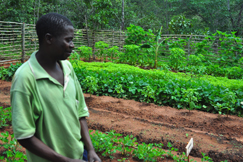
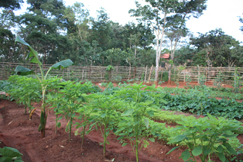
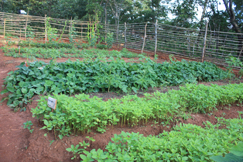
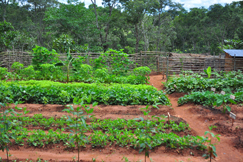
In the middle of the miombo forest, typical of central-southern Tanzania and characterized by the dominance of leguminous trees, a steep path lined with fruit trees and flowers leads to the food garden: a sloping plot of around a third of a hectare, bounded by a fence made of wood and bamboo canes.
The garden is part of a training center for sustainable agriculture set up by CO.P.E., an Italian NGO, in Msindo, a remote village in southern Tanzania not far from the Mozambican border.
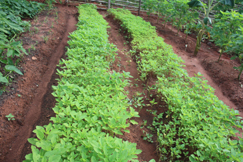
The first section is home to a selection of plants collected from the forest (mlenda, mapwete, masuku trees), a raised nursery protected by a straw roof and a small chicken coop. A fence separates the second section, dedicated to domestic plants: different types of amaranth, black-eyed peas, bambarà beans, okra, sorghum and kata, a squash used to make traditional cups. All the seeds were gathered from communities in nearby villages, after research involving interviews with the elderly and women. In the midst of the vegetables are some banana trees, while around the fences climbing potatoes, taro and yam have been planted. All around the perimeter, outside the fence, are fruit trees (mango, papaya, orange, lemon, guava, mapera, karangamiti) and some medicinal plants (neem and Moringa oleifera).
A rectangular cement well collects rainwater. Next to the entrance, a traditional small house made from wood, mud and straw is used to store work tools, old millstones and various containers.
This pilot food garden, the result of a collaboration between Slow Food and CO.P.E. and funded by the Veneto Regional Authority, will be used to train young people at the center and will serve as a model for communities and schools throughout the region.

Garden Location
CO.P.E training center for sustainable agriculture, Msindo village, Namtumbo district, Ruvuma region (southern Tanzania)

Coordinators
Two teachers from the center, Joseph Kapungo and Makrina Komba, and Sandra Gasbarri from CO.P.E., who is leading the project, created the garden and carried out the research in the villages.
Products

  • Sweet potato
  • Tomato
  • Garlic
  • Onion
  • Bean
  • Cowpea
  • Okra
  • Sorghum
  • Chinese spinach (A. dubius)
  • Banana

Slow Food in Tanzania

Slow Food has been developing activities in Tanzania since 2004, when over 20 delegates from the country participated in the first Terra Madre event in Turin, Italy. Now local Slow Food groups are promoting good, clean and fair food across the country, primarily in the north (Kilimanjaro, Meru and Arusha), along the coast (Dar es Salaam region) and in the central-east (Morogoro, Dodoma and Singida). The largest country along Africa’s eastern coast, Tanzania experimented with “Ujamaa” socialism under President Julius Nyerere, one of Africa’s most enlightened 20th-century politicians, who led the country after independence in 1961. Much was invested into education and literary programs, community development and the agricultural sector. Positive effects, such as a lively and pervasive entrepreneurial spirit, can still be seen in this relatively stable country, despite the devastating spread of HIV, which has laid waste to multiple generations and left thousands of orphans, profoundly changing family and social structures. Women, particularly those who are now elderly, are confident and educated, and can act as agents of important change at a socio-political level and as the driving force behind local economies. The initiatives carried out by the Slow Food network to create awareness, achieve food sovereignty and improve everyday nutrition include the safeguarding of traditional beekeeping, the rediscovery of wild vegetables and herbs, the mapping of local banana varieties, the integration of food-growing into school programs, the spread of agroecological practices to improve farmers’ resilience and autonomy and the valuing of the role of young people in training and awareness-raising activities. The major challenges to be addressed are linked to the lack of availability of native seeds and organic inputs, thanks to government policies that favor industrial agriculture and allow foreign investors to indiscriminately take over arable land. In January 2017, the Tanzanian government passed a law that gives Western agribusiness investors faster and better access to agricultural land and strong protection of intellectual property rights, in exchange for development aid. Under this new law Tanzanian farmers are subject to a minimum jail term of 12 years and a fine of over €200 if they sell seeds that are not certified.

Garden Informations

Type:School Garden
Surface in m2:1349
People involved:3
Slow Food Convivium:COPE Ngo
Coordinator:Urban Ndunguru
Sibling with:Slow Food Vigevano Lomellina Convivium, Italy

Photos

Subscribe to the newsletter

Slow Food gratefully acknowledges funding support from European Union. The contents of this website are the sole responsibility of Slow Food and the CINEA is not responsible for any use that may be made of the information contained therein.
Slow Food - P.IVA 02743970044 - Privacy Policy - Cookie Policy - All rights reserved
Powered by Blulab