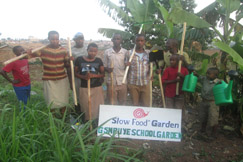
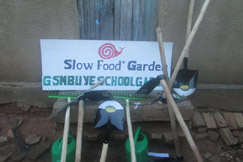
The Mbuye garden, with its 83 are of terrain, was formed in 2013 in Vugiza, a small hill in Ruhango Province, Mbuye sector of the Southern Province of Rwanda.
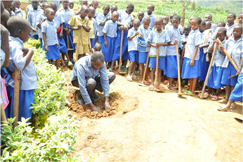
The school that manages the garden has more than 1,400 students and 12 teachers. The plot is cultivated primarily by the youngest students, up to those in the sixth grade, while the remaining students work the garden in a more limited role, through their ninth year of studies (as the school has both elementary classes and middle school classes).
The garden is managed by the members of the environmental club through a committee elected by the members. The students’ parents support the committee’s activities by selling the garden’s produce in the market after it is harvested.
Not only is this garden useful for the production of food, but it is also helpful for the students and teachers, acting as a didactic instrument in various lessons: agriculture, cooking, sciences and environmental studies, and botany.
Once a month about 30 young volunteers from the Nyamabuye-Gitarama Slow Food Convivium come to this school to help teach and raise awareness, to check on the garden’s activities and to work with the students to give them a helping hand. The kinds of food produced on this plot of land are many and varied: there are vegetables, fruits (pineapple, passion fruit, plums), banana trees, medicinal plants (like Moringa and garlic), and a wealth of cassava. In fact, this region is famous for its cassava production and for the high quality cassava flour produced here.
The garden’s enclosure is made of grasses that serve to feed the domestic animals and which are also useful against erosion (like setaria and similar plants).
The fertilizers used are a mixture of compost and manure, which comes from the school’s three cows. To protect against pests the students use natural products like ashes and flour made from spicy peppers.
Area
Ruhango Province, Mbuye Sector, Southern Province
Coordinator
Clement Misago