Slow Food
  • Donate
  • Join us
  • Italian
  • English
Slow Food Foundation

Search

  • Home
  • About us
    • What is the Foundation?
  • What We Do
    • Slow Food Gardens in Africa
    • Slow Food Presidia
    • Ark of Taste
    • Slow Food Cooks’ Alliance
    • Earth Markets
    • What is the Narrative Label?
  • Get involved
    • Why Support Us
    • Italian Slow Food Presidia Sponsors
  • Multimedia
    • Publications
    • Video
    • Gallery
    • News archive
    • Photo archive
  • Contacts
Slow Food Foundation Slow Food Foundation
  • Home
  • About us
    • What is the Foundation?
  • What We Do
    • Slow Food Gardens in Africa
    • Slow Food Presidia
    • Ark of Taste
    • Slow Food Cooks’ Alliance
    • Earth Markets
    • What is the Narrative Label?
  • Get involved
    • Why Support Us
    • Italian Slow Food Presidia Sponsors
  • Multimedia
    • Publications
    • Video
    • Gallery
    • News archive
    • Photo archive
  • Contacts

Search

Home » 10.000 Orti in Africa » Makumira School Garden

Makumira School Garden

Back to the archive >

Tanzania

Arusha

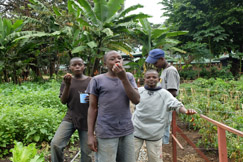
The Watoto Foundation (http://www.watotofoundation.nl/en/) Child in the Sky Centre is a community-based support boarding school for disadvantaged youth and more specifically street children. The centre accomodates on average 60 boys, ages 13 up to 19 years old, and has already served more than 550 street children from all backgrounds since its establishment ten years ago.
The Watoto Foundation is situated in Makumira Village, 20 km outside Arusha City in northern Tanzania, and is set in nearly 17 acres of farmland. It has sufficient water (a mix of furrow and drip
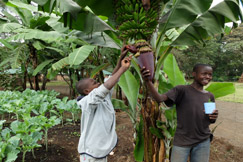
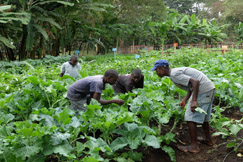
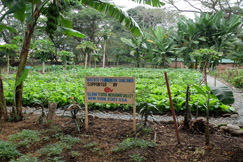
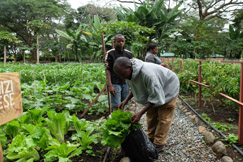
irrigation) to conduct agricultural activities, including horticulture and animal husbandry.  The centre owns 11 dairy cows, 2 calves, 6 sheep, 12 goats, 93 pigs, 53 rabbits, 1,200 layers hens. The land is cultivated with Arabica coffee, banana trees, maize, different varieties of vegetables (okra, cocoyam, cucumbers, cabbage, sweet potatoes, spinaches, cassava, tomatoes, pumpkins, amaranth, lemongrass and beans to name a few) and some fruit trees such as papaya, guava, avocado, mango, and orange. 45 boys take care of the garden and the ones who do better in the horticultural activities are given the chance to visit another Slow Food garden in the area. The soil is watered thanks to an irrigation pipes system. Natural plants like neem, aloe vera and marigold are used as insects repellents.  There is also an on-site biogas production scheme, which utilizes the animal waste to contribute to energy needs.  Furthermore, the foundation is affiliated with a tourist operation (Kiboko Lodge), which employs many of the older boys and trains them in cooking, hotel management, and business.  The Watoto Foundation boys grow food for home consumption, the lodge, and some small sales (eggs, meat, milk etc.).
In addition to livestock and farming activities, the boys attend workshop-style classes in carpentry, masonry, electrical installation, welding, and car and bicycle repair, as well as more traditional coursework in English, Mathematics, career guidance, and counseling alongside behavior change lessons. Every morning, the boys attend four hours of academic classes (and primary school studies for those who didn’t attend) and in the afternoon, they engage in practical, skill-based/trade lessons, before given ample time to stretch their legs on the sports fields.
In summer 2013 the centre was visited by Lauren Howe, a Slow Food member and recent graduate from Hamilton College in Clinton, New York (where she co-founded and co-led the college’s Slow Food convivium) and Helen Nguya, Tanzania’s Northern Zone Slow Food gardens coordinator.
They interacted with the boys in their existing gardening activities, including taking a tour of the grounds and participating in weeding. Helen and Lauren observed first-hand how the boys are self-motivated, committed, and genuinely wishing to improve their existing farming activities. In addition to visiting the foundation, Helen and Lauren accompanied the boys and their teachers on two field trips to nearby, community-based Slow Food garden projects to glean more information about agricultural techniques. Again, the boys displayed an impressive amount of politeness, maturity, curiosity, and enthusiasm to learn more about best practices and environmental sustainability with regard to agriculture.

Slow Food Mohawk Valley Convivium (U.S.) has fully embraced the activities of the Watoto Foundation and decided to support a Slow Food garden. The link with a Slow Food Convivium allow the Watoto Foundation boys to connect with children and teenagers from Utica, New York, as
the proposed “partner garden” (100 raised beds, built with the assistance of the New York State Health Department) is located across from the Utica Public Library and is a host site for youth programming and education.
Slow Food in Tanzania

Slow Food has been developing activities in Tanzania since 2004, when over 20 delegates from the country participated in the first Terra Madre event in Turin, Italy. Now local Slow Food groups are promoting good, clean and fair food across the country, primarily in the north (Kilimanjaro, Meru and Arusha), along the coast (Dar es Salaam region) and in the central-east (Morogoro, Dodoma and Singida). The largest country along Africa’s eastern coast, Tanzania experimented with “Ujamaa” socialism under President Julius Nyerere, one of Africa’s most enlightened 20th-century politicians, who led the country after independence in 1961. Much was invested into education and literary programs, community development and the agricultural sector. Positive effects, such as a lively and pervasive entrepreneurial spirit, can still be seen in this relatively stable country, despite the devastating spread of HIV, which has laid waste to multiple generations and left thousands of orphans, profoundly changing family and social structures. Women, particularly those who are now elderly, are confident and educated, and can act as agents of important change at a socio-political level and as the driving force behind local economies. The initiatives carried out by the Slow Food network to create awareness, achieve food sovereignty and improve everyday nutrition include the safeguarding of traditional beekeeping, the rediscovery of wild vegetables and herbs, the mapping of local banana varieties, the integration of food-growing into school programs, the spread of agroecological practices to improve farmers’ resilience and autonomy and the valuing of the role of young people in training and awareness-raising activities. The major challenges to be addressed are linked to the lack of availability of native seeds and organic inputs, thanks to government policies that favor industrial agriculture and allow foreign investors to indiscriminately take over arable land. In January 2017, the Tanzanian government passed a law that gives Western agribusiness investors faster and better access to agricultural land and strong protection of intellectual property rights, in exchange for development aid. Under this new law Tanzanian farmers are subject to a minimum jail term of 12 years and a fine of over €200 if they sell seeds that are not certified.

Garden Informations

Type:School Garden
Surface in m2:600
People involved:50
Slow Food Convivium:Lishe Convivium
Coordinator:Helen Tibandebage Nguya
Sibling with:Slow Food Mohawk Valley Convivium, USA

Photos

Subscribe to the newsletter

Slow Food gratefully acknowledges funding support from European Union. The contents of this website are the sole responsibility of Slow Food and the CINEA is not responsible for any use that may be made of the information contained therein.
Slow Food - P.IVA 02743970044 - Privacy Policy - Cookie Policy - All rights reserved
Powered by Blulab