The Fantalle area is one of the most important conservation areas in the Ethiopian lowlands, inhabited by Karrayyu Oromo pastoralists, one of the last remaining Oromo groups to maintain the pastoralist way of life. Fantallle is semi arid and characterised by acacia woodland and savannah. However, the area is suffering from deforestation and extreme degradation which is impacting on the local climate and population. The development of a national park and sugar plantation have meant loss of grazing land and loss of access to the Awash River. The consequences are devastating for the Karrayyu pastoralists, who are now struggling to survive. A large scale irrigation scheme has recently been introduced with the aim of converting the Karrayyu to farming, which will represent a fundamental change in livelihood. There is a lack of knowledge and resources among the community for farming to be successful without support.
The main goal of the Galcha Community Garden is to assist Karrayyu Oromo pastoralists to find ways forward during a time of massive change. The garden will act as model of sustainable arid land development for Fantalle woreda (area). The local NGO Labata Fantalle, established by Karrayyu community members, will work to develop crop and livestock systems which meet both the needs of community members and the local environment. The overall objective is to improve local livelihood security and environmental management through sustainable, participatory community development.
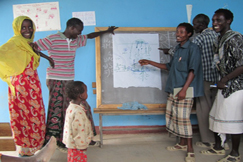
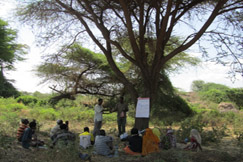
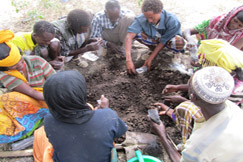
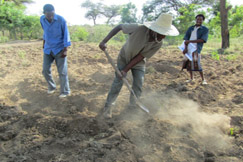
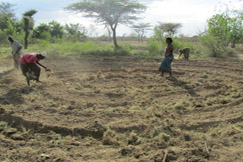
The local government has granted Labata Fantalle the use of a 3 hectare site located in Galcha. Community members have participated in a Permaculture training held by the national coordinator of the Thousand gardens project, Tichafa Makovere. There is the beginning of a small tree nursery consisting of both indigenous and exotic trees, community members have created designs on the site that will help to conserve both soil and water and enable them to grow vegetables. Drought resistant varieties of sorghum have been planted and multipurpose trees have been introduced which can be used for both food production and animal fodder. Community members have begun channeling water to the site, and have planted a living hedge using locally available prickly pear cactus.
For the future the community is planning to introduce a variety of suitable food and fodder crops, poultry and beekeeping, model compost toilets, rain water harvesting techniques, earthworks for water and soil conservation as well as an outdoor classroom, seed bank and storage facility for community training. The long term aim is to experiment with alternative farming models which can incorporate traditional Karrayyu values and collective ways of living and working which are essential to pastoralist culture and way of life.
The garden project will target vulnerable community members, particularly female headed households and those with low incomes. In addition the project will include development agents and local teachers. Labata Fantalle aims to form links with local schools and encourage active pupil participation, particularly from members of environmental youth clubs.
Garden Location
Labata Fantalle Garden, Galcha kebele, Fantalle woreda, East Shewa, Oromia, Ethiopia
Coordinators
Fantalle Gile, Aliyyi Kasaru and Oda Boru have been assisting the delivery of Permaculture trainings and site development