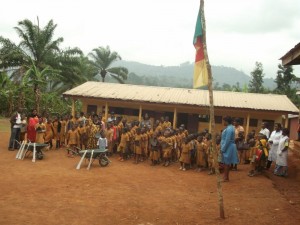
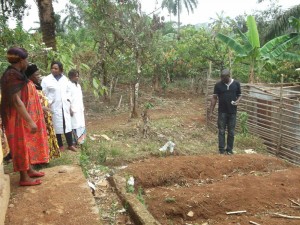
Tounofah public school, which hosts this garden, is situated behind the traditional supreme chieftaincy of the Bafang group. Administratively, this land belongs to the government of the Bafang neighborhood, capital of the Haut-Nkam department, in Western region. The garden is divided between two plots of land within the school’s grounds of about 200 m2 each.
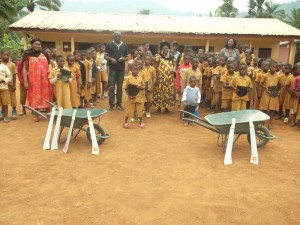
The acquisition of gardening materials (hoes, machetes, wheel barrows, hoses and support beams) that were necessary to create the garden were all provided by Slow Food. The students work in the garden with the help of their teachers and the members of the Bafang community (a convivium dedicated to raffia palm trees). Some of the products grown in the garden are: garden vegetables, beans (a climbing variety), maize, and okra. The students gather seeds from their houses, while others are offered by the Bafang community.
The gardening techniques in use are very simple. The crops are planted according to the seasonality of the region. The students till the soil with hoes and shovels before planting the seeds. After which they fill the trenches with cow manure, as the shepherds are often in the region with their flocks in search of fresh herbs. The garden’s management is taken care of by the school, which must report to the leaders of the Bafang community. The harvest is sold and the revenue is used to buy new equipment for the school’s pharmacy, in order to provide first aid to the students and teachers in the school.
The garden also acts as an experimental classroom for the students who learn from a very young age how to work the land and its great importance. In this way they can help their parents at home, most of whom are farmers in the region.
Area
Tounofah quarter, Bafang neighborhood, Haut-Nkam department, Western region
Coordinators
Tiassom Simplice
Satai Happi Yannick
Edima Patricia
Ndzie Eugénie