Slow Food
  • Donate
  • Join us
  • Italian
  • English
Slow Food Foundation

Search

  • Home
  • About us
    • What is the Foundation?
  • What We Do
    • Slow Food Gardens in Africa
    • Slow Food Presidia
    • Ark of Taste
    • Slow Food Cooks’ Alliance
    • Earth Markets
    • What is the Narrative Label?
  • Get involved
    • Why Support Us
    • Italian Slow Food Presidia Sponsors
  • Multimedia
    • Publications
    • Video
    • Gallery
    • News archive
    • Photo archive
  • Contacts
Slow Food Foundation Slow Food Foundation
  • Home
  • About us
    • What is the Foundation?
  • What We Do
    • Slow Food Gardens in Africa
    • Slow Food Presidia
    • Ark of Taste
    • Slow Food Cooks’ Alliance
    • Earth Markets
    • What is the Narrative Label?
  • Get involved
    • Why Support Us
    • Italian Slow Food Presidia Sponsors
  • Multimedia
    • Publications
    • Video
    • Gallery
    • News archive
    • Photo archive
  • Contacts

Search

Home » 10.000 Orti in Africa » Addis Ababa Educational Garden

Addis Ababa Educational Garden

Back to the archive >

Ethiopia

Addis Ababa

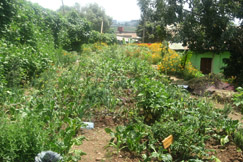
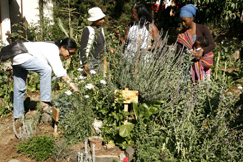
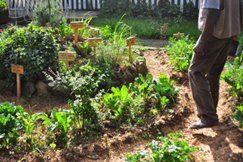
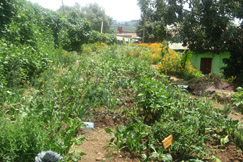
In Addis Abeba, in the heart of the Italian Piazza neighborhood, is the Taitu Hotel. The building dates back to 1898 and takes its name from emperor Minilik’s wife, who had the oldest hotel in Ethiopia built. Tichafa Makovere Shumba – coordinator of the One Thousand Gardens project in Ethiopia – has urned the hotel ornamental flowerbeds into an actual agro-ecological garden. The approach is that of "guerrilla gardening", namely gardening the green spaces spared by the aggressive overbuilding of cities. Several species are grown in this garden. In front of the hotel main entrance, welcoming guests, are indigenous varieties: ensete ventricosum (also known as false banana, a tree whose roots are the key staple food for the people of southern Ethiopia), hagenia abyssinica, kosso, and coffeea arabica, a very common crop on Ethiopian plateaus. A bit further away are a few specimens of Ethiopian wild olive trees, ruta graveolens, a shrub used for medicinal purposes, in the kitchen and as ornamental plant which can resist dry soils, and ocimum lamifolium, the African ancestor of our basil. Plants are distributed on various parcels which, taken all together, cover about one and a half acres. At the edges of the garden, a pergola of climbing beans protects hotel guests from intrusive gazes and helps fix nitrogen in the soil, enriching it with fundamental substances. In a more sheltered area, a few unused tires, washbasins and bathtubs have been recycled as pots to grow vegetables.
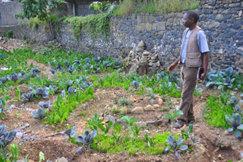
The design of the soil streaked by concentric canals allows to convey water, thus limiting wastes and erosion. Sowing at different stages allows a constant provision of vegetables and a continuous production throughout the year. This is possible wherever there is a bimodal rainfall pattern. Seeds are reproduced on site, selecting and drying the best specimens in the sun. Compost is obtained by fermenting brushwood and other scraps.
An advice of an Italian cook who has been managing the Taitu Hotel restaurant for a few months, was essential to choose the right varieties to plant and then use in the hotel kitchen. The result is a beautiful garden which produces fresh ingredients for customers as well as extra products sold at the local market. The Taitu Hotel vegetable garden also has a very important educational role. As it is located in a good and busy position, it can be accessed by both the hotel guests and the citizens of the Ethiopian capital city.

Area
Taitu Hotel, Addis Abeba

Coordinator
Tichafa Makovere Shumba
Slow Food in Ethiopia

Slow Food has been active in Ethiopia since 2006, launching numerous projects in support of the most vulnerable local communities: nomadic herders, traditional forest beekeepers, wild coffee harvesters, indigenous groups and others. Through the Presidia and working with the communities, training activities have been run to strengthen the organization of small-scale producers and to promote and improve the quality of various foods like honey, camel milk, coffee, traditional grains and spices. Slow Food coordinators promote agroecological techniques—applying them in school and community food gardens—in the most diverse ecosystems, from forests and highlands to nature reserves and semi-arid zones. They are also working to save biodiversity and traditional knowledge. A number of educational projects have objectives that include the involvement of young people and women and awareness-raising around themes of strategic importance at a national and international level: the privatization of resources, the use of toxic chemicals in agriculture, the right to land. Educational materials have been produced in Amharic and Oromo, the main local languages. Every year, Ethiopian delegates participate in Slow Food’s international events (Salone del Gusto and Terra Madre, Indigenous Terra Madre, Cheese, Terra Madre Giovani and more) as well as other events thanks to collaborations with different organizations.

Garden Informations

Type:School Garden
Coordinator:Tiginesh Mitik Beyene
Sibling with:Milan Earth Market, Italy

Photos

Subscribe to the newsletter

Slow Food gratefully acknowledges funding support from European Union. The contents of this website are the sole responsibility of Slow Food and the CINEA is not responsible for any use that may be made of the information contained therein.
Slow Food - P.IVA 02743970044 - Privacy Policy - Cookie Policy - All rights reserved
Powered by Blulab