


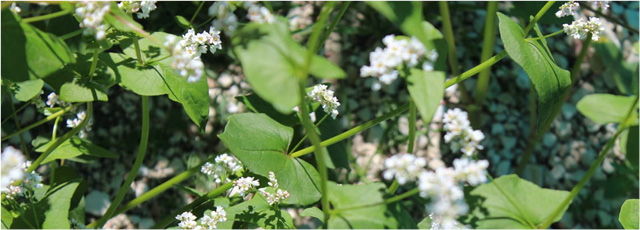
The etymology of the Italian name for buckwheat, grano saraceno, is curious: The adjective "saraceno," or Saracen, does not indicate a precise origin, but signifies a distant provenance, while "grano," or grain, refers to its similarity to cereal grains, even if the botanical family is different (Polygonaceae rather than Poaceae), making buckwheat a pseudo-grain.
Cultivated in the mountainous areas of the Alpine arc and the Apennines, buckwheat has found an ideal environment in the Terragnolo valley, at the foot of Monte Maggio and Monte Pasubio, in the province of Trento, where it is grown in small plots on terraced land.
Official sources can trace the cultivation of buckwheat, also known locally as formentom, back to the 19th century, but according to folk history it has been grown here since at least the 16th century. The First World War, which displaced many of Terragnolo’s inhabitants to Austria, could have led to the abandonment of the crop, but luckily a number of farmers preserved the seeds and redistributed them to the valley dwellers when they returned to their land.
Buckwheat is well suited to the middle mountain environment because it is resistant to cold and needs a regular supply of water. The plant has a short growing cycle, so it can easily be rotated with other crops (winter legumes, wheat, barley, potatoes, rye, corn), and does not require fertilizers or other chemical treatments.
Traditionally the crop is sown from after the Feast of St. Peter and St. Paul, at the end of June, up until the end of July. Around 80 kilos of seeds are scattered per hectare, then the seeds are harvested by hand from the end of September, once the spikes have reached 70% maturity. The plants are then fully ripened in the fields in typical donete, bundles that recall the outline of a woman wearing a long skirt. More rarely, buckwheat is harvested with combine harvesters, in which case farmers must wait until 80% to 90% of the achenes (the triangular fruits that contain the seeds) have darkened.
Buckwheat can be processed into middlings, groats and flour. The lack of gluten means buckwheat flour cannot be used on its own to make bread, but it can be mixed with other flours. Buckwheat is also used to make polenta mora, referenced in Alessandro Manzoni’s classic I promessi sposi as "grey buckwheat polenta," but Terragnolo’s most typical buckwheat dish is fanzelto. These crêpe-like flatbreads are made by mixing buckwheat flour, water and salt into a soft, creamy batter. Many add grated raw potato before cooking the batter in a hot cast-iron pan with a long wooden handle, greased with lard. The fanzelto is ready when both sides are browned, and is generally served with cheese and slices of luganega sausage.
Season
Available all year round
Back to the archive >However, a group of farmers united in the Presidium is continuing to grow buckwheat on the mountain slopes, maintaining this rural tradition and the typical terraced landscape. Buckwheat could represent an element of economic revival for the valley, thanks not only to its products but also its value to apiculture, while the drystone wall terracing is a fascinating architectural feature and an example of the harmonious integration of human activities into the mountain environment.
Production area
Terragnolo municipality, Trentino-Alto Adige region, Italy
Supported by:
Italian Ministry of Labor and Social Policies
The Terragnolo Buckwheat Presidium is financed by the Italian Ministry of Labor and Social Policies, Directorate General of the Third Sector and Social Responsibility for Enterprises—notice no. 1/2018 “Slow Food in azione: le comunità protagoniste del cambiamento,” in accordance with Article 72 of the Third Sector code, as per Legislative Decree no. 117/2017.
Associazione Terragnolo Che Conta
Frazione Valgrande, 5
Terragnolo (Tn)
Tel. +39 349 8489953
terragnolocheconta.aps@gmail.com
It harvests and processes the grain of:
Leonardo Gerola, Davide Gerola, Paolo Gerola, Willy Gerona, Christian Mariotti, Chiara Peterlini, Fabio Peterlini, Barbara Prosser, Riccardo Scrinzi, Sebastiano Stedile, Fiorenzo Stedile, Francesco Stedile, Massimo Stofella, Giulio Zencher, Elena Zeni.
Riccardo Scrinzi
Tel. +39 340 7573903
riccardo.scrinzi@gmail.com
Slow Food Presidium Coordinator
Tommaso Martini
Tel. +39 349 1696718
tommasomartini@gruppomartini.net
