


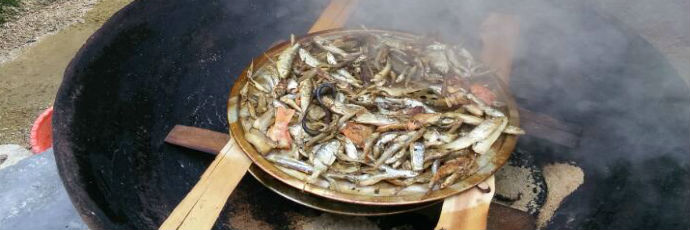
米糠熏河鱼干
Rice-bran-smoked river fish is a typical product of Hakka communities living in the mountains of Jiangxi, southeast China. During the spring and summer, small fish (usually weighing less than 50 grams) are caught using traditional methods, eviscerated, and baked for 3 hours in order to dry them out. The dried fish are then smoked according to the following process: First, rice bran is deposited in the bottom of a wide, heavy wok, forming a layer about 5 centimeters thick. Next, bamboo or wooden slats are positioned in the wok to form a grid-like structure upon which plates of dried fish are placed. Meanwhile, a fire is lit in a cylindrical, open-top stove (essentially a metal drum on legs). The wok is covered with a wooden lid and placed on top of the stove, allowing the rice bran to ignite. There is a hole in the side of the stove so that fuel can be added to the fire once the wok is in position. It only takes 3-5 minutes to smoke the fish. Once smoked, the fish have a pleasant fragrance and a golden-brown color.
In July, during the “double rush” season (so named because this is the time when the first rice crop is harvested and the second crop is planted), it was traditional for community members help their neighbors with the huge amount of work that had to be accomplished. In exchange for their labor, workers were compensated not with cash, but with three meals a day. Hosts were expected to prepare meat, fish, tea, liquor, and the like. Rice-bran-smoked river fish is a particularly convenient food source because it is homemade (and thus costs almost nothing to obtain) and it stores easily throughout the summer. There is a saying among Hakka people from the mountains of southern Jiangxi, that “people can’t be feasted without fish or tea.” Today, the practice of preparing rice-bran-smoked river fish is declining: Industrially produced alternatives are cheap and widely available and people are generally not intent to learn or pass down the traditional techniques.
Back to the archive >
