


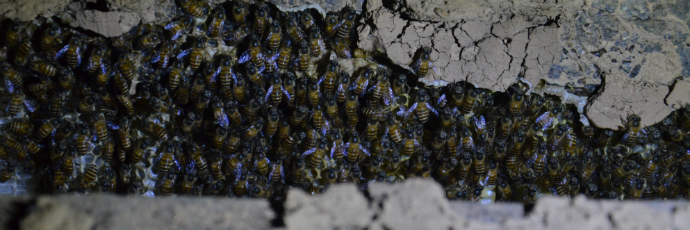
The domestic honey has a pivotal role for the ecosystem and the energy intake of the Gurung villages. The Gurungs live off of farming, in mountain villages encompassed by terraced fields. They carry stones, soil and water up and down; therefore, the energy intake must be massive. The method provides bee with a shelter during the wet seasons of the monsoon, and allow local plants in the villages to be impollinated, as the Gurung are strictly dependent on subsistence agriculture.
When it comes to the hives, they are positioned inside the Gurung households, on the second floor. There, among stockpiles – potatoes at most – the hive is kept in a narrow space between a clay-fixed wood panel and the window that allows bees – especially Apis cerana e Apis dorsata – to get in and out. The clay fixing the panel to the wall is broken with a careful hit; nonetheless, bees become aggressive and some of them start attacking. When the others get calm, the hive is taken and squeezed to get the honey. If honey is not ready, the panel is reattached with some new and wet clay. Honey is produced two or three times per year, depending on the amount of bees and flowers around. Young people have the task of caring of these domestic hives. Regrettably, most of them are attracted by the major opportunities bigger centres may offer, hence they leave the village to a process of ageing. Moreover, the less they care of hives, the less impollination occurs in the village, disturbing its homeostasis built around the seasonality of the crops.
The domestic honey is very sweet and caloric, and it comes from the brassicaceae family plants – such as broccoli, cauliflower and mustard – at most.
The domestic honey is used as dulcifier into breakfast preparations: into selroti (fried round-shaped rye bread, usually served with fried soybeans), into soft wheat chapati (cooked on fire), into chyia (the local tea), into rachsee (local wheat spirit) consumed during the day or in the evening.
Image: © Giovanni Marabese
Back to the archive >

