


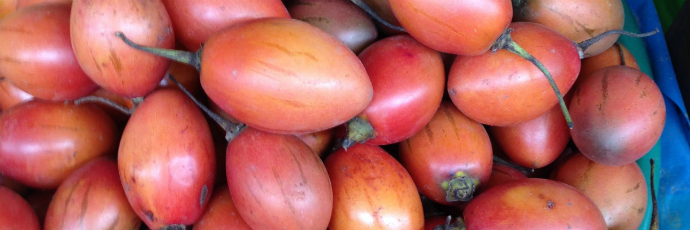
Tomate de arbol
Sachatomate, also known as tomate de arbol, is a small perennial shrub, native to the area between Ecuador and the Andean Peruvian valleys.
Scholars think that this is also the area, in which the shrub was first domesticated. The ideal habitat for its cultivation is on altitudes between 1500 and 3000 meters above sea level; these areas are characterized by temperatures between 13 and 24 degrees Celsius and an annual precipitation of about 1200 mm. These climatic conditions can be found in the Peruvian Departments of the Sierra, e.g. Huanco, which comprises the area of Umari.
Sachatomate is cultivated in this area, and some varieties are still grown on a small scale, using traditional methods: the sowing occurs using dried seeds of the previous harvest.
The sachamote plant starts bearing fruits about 12 month after the definite grafting, and the fruits are available all year round, even if the best time for harvesting it is between May and December.
The fruit has an oval shape and a very thin skin, which varies in color between orange and red, depending on the grade of ripeness. On the inside there are many seeds and the pulp is very juicy, aromatic and acidic.
Andean populations use sachatomate as a food to compensate for vitamin, mineral and micronutrient deficiency.
It is a very important product, not only on a gastronomic level, but also because it is the base of the local economy in these Andean areas. The cultivation of sachatomate is threatened by climatic changes and deforestation.
The most common way of consuming it is raw, in juices and jams, or to accompany sweet or savory dishes.

