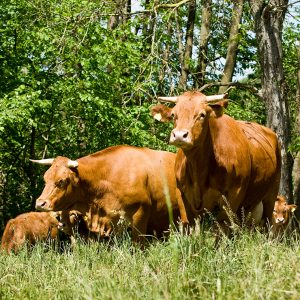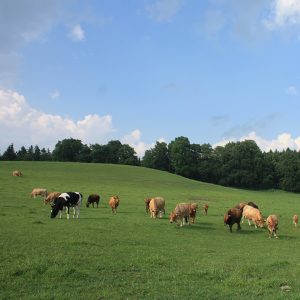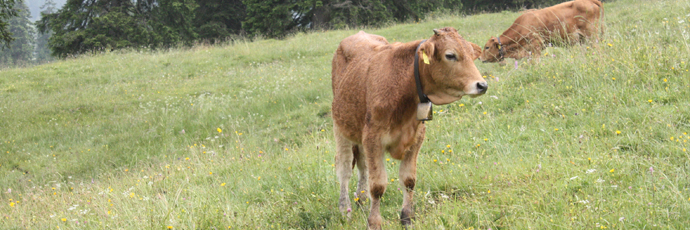
The Limpurg cow breed represents the oldest still existing cow breed in Württemberg.
Its name derives from the county of Limpurg , south of the city of Schwäbisch Hall. It came into existence from breed crossings between the local red breed, which was present after the 30 Years War and the breed Allgäuer (named after the region between south-west Bavaria and south of Baden-Württemberg).
Particularly suited for the wild breeding, even on steep pastures, it is perfect for the mixed landscape which is characterized by hills, mountains, the Swabian-Franconian forest and the low river valleys of the rivers Rems and Lein.
In the past, the great proliferation of markets in the region favoured its development: the animals, in fact, served both to transport and to provide meat and milk.
Already in the 18th century in the area of Hohenlohe, on the northern part of Baden Württemberg fattening of oaxen had become the most important business, guaranteeing farmers a degree of prosperity.
According to written records of the 19th century, the Limpurg oax was known as “particularly tender, juicy and tasty” and was preferably sold outside of the regional borders (France and Switzerland) where a higher price for top quality meat was willingly paid.
The color of the animals’ coat can vary from yellow to red-yellow. Stamina, long living, double attitude (milk and meat) well-developed shoulders and good musculature strong brisket, regular limbs with hard hooves, fine bone structure and good properties characterize the strong and sturdy breed as a nurse cow.
The Presidium focused besides safeguarding the breed in particular on the breeding of the Limpurg oxen, which become extremely large and heavy and give a high yield when slaughtered. The meat has especially fine fibers, is low in fat, juicy, tender and well marbled, particularly that of cattle raised on pasture and during the winter, using only hay pasture, without the addition of soybean or silage.
The Presidium was founded in 2009 in cooperation with the association of cattle breeders of Limpurg (located in the city of Schwäbisch Hall), to revive sustainable and traditional breeding methods. Today there are more than 650 animals including 350 cows registered in the herd book, which is still a very small population. Due to the limited population, no young animals are slaughtered, only heifers and pasture oxen. The quality of this meat has been famous for its quality for over two centuries. The Presidium is focussing in particular on the pasture oxen, trying to promote and obtain compensation for farmers.
Production area
Swabian-Franconian forest around Schwäbisch Hall, Hohenlohe district, Baden-Württemberg
The Presidium is supported by
Community Marketing Baden-Württemberg (MBW)
Dieter Kraft
Tel. +49 79047007519
limpurger@rind-bw.de
Heinrich Leutenberger
Tel. 0049 +7131/70078
leutenberger@web.de