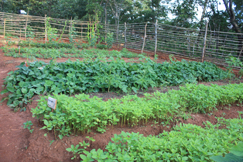
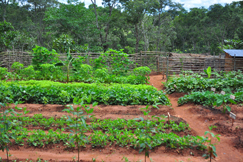
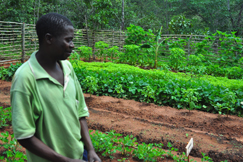
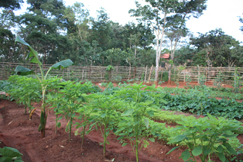
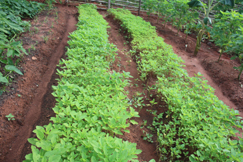
In the middle of the miombo forest, typical of central-southern Tanzania and characterized by the dominance of leguminous trees, a steep path lined with fruit trees and flowers leads to the food garden: a sloping plot of around a third of a hectare, bounded by a fence made of wood and bamboo canes.
The garden is part of a training center for sustainable agriculture set up by CO.P.E., an Italian NGO, in Msindo, a remote village in southern Tanzania not far from the Mozambican border.
The first section is home to a selection of plants collected from the forest (mlenda, mapwete, masuku trees), a raised nursery protected by a straw roof and a small chicken coop. A fence separates the second section, dedicated to domestic plants: different types of amaranth, black-eyed peas, bambarà beans, okra, sorghum and kata, a squash used to make traditional cups. All the seeds were gathered from communities in nearby villages, after research involving interviews with the elderly and women. In the midst of the vegetables are some banana trees, while around the fences climbing potatoes, taro and yam have been planted. All around the perimeter, outside the fence, are fruit trees (mango, papaya, orange, lemon, guava, mapera, karangamiti) and some medicinal plants (neem and Moringa oleifera).
A rectangular cement well collects rainwater. Next to the entrance, a traditional small house made from wood, mud and straw is used to store work tools, old millstones and various containers.
This pilot food garden, the result of a collaboration between Slow Food and CO.P.E. and funded by the Veneto Regional Authority, will be used to train young people at the center and will serve as a model for communities and schools throughout the region.
Garden Location
CO.P.E training center for sustainable agriculture, Msindo village, Namtumbo district, Ruvuma region (southern Tanzania)
Coordinators
Two teachers from the center, Joseph Kapungo and Makrina Komba, and Sandra Gasbarri from CO.P.E., who is leading the project, created the garden and carried out the research in the villages.