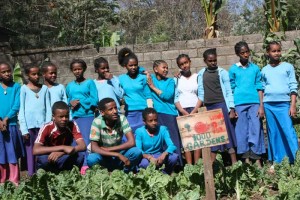
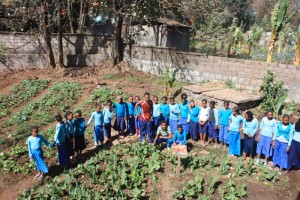
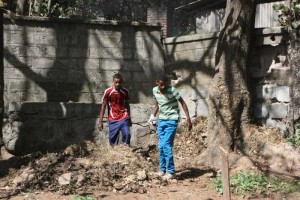
Meskerem elementary school is a large school, educating more than 1,000 school children, from grade one through eight. It is located in the centre of Addis Ababa, the capital city of Ethiopia, in Arat kilo, behind the presidential palace. Up the hill from the school there is an ancient church called Baata Mariam, built by the late Emperor Menilik. Due to the concentration of old indigenous trees in Baata Mariam church, a small stream of clean water flows down the hill from the church all the way through the Meskerem school garden. Abebe Negeri Kelbessa, a science teacher, discovered this stream of water flowing through the school. He mobilized 3 of his students and together they cleaned up and cleared the land behind the school building and developed a beautiful garden, on 500m2, by irrigating the stream water.
As a result of the training organized by the local Slow Food Ethiopia representatives, the garden has been diversified and the following varieties of vegetables are cultivated: lettuce, swiss chard, tomatoes, beet roots, potatoes, red onions, garlic, cabbage, kale, carrots and ensete (false banana plant, indigenous to Ethiopia). Thanks to the exchange of local seeds during training, this garden now includes an Ark of Taste product, Anchote, as well as local varieties of beans (lab-lab and kidney beans), both of which are seeds produced by other Slow Food gardens in Addis. In order to prevent soil erosion and to collect water, Abebe and his students have created small steps and terraces. The garden is surrounded by large “korch” trees (Erythrina brucei, a tree variety indigenous to Ethiopia, and useful for improving the soil and as a bee forage).
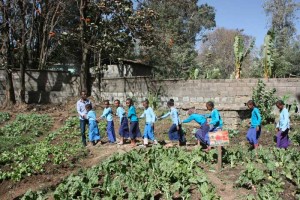
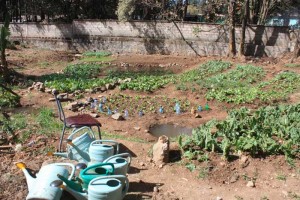
The school children contribute to the compost preparation process by bringing fruit peelings from home. In addition the children take turns watering the garden five at time, using small watering cans that have been supplied. The produce of the garden is regularly harvested and the school children who actively work on the garden are allowed to take vegetables from the garden for home consumption. Some of the garden’s produce is sold and the money collected from the sales of vegetables is used to support the school club and to buy school supplies for low income children who don’t have parents to support them.
The garden project has drawn the attention of government officials from the Ministry of Agriculture, which has promised to supply the garden with seedlings of indigenous fruit trees as well as technical support.
Area
Addis Abeba, Arat Kilo
Coordinator
Tiginesh Mitik Beyene