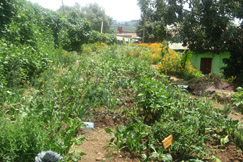
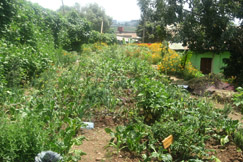
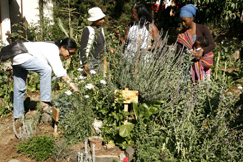
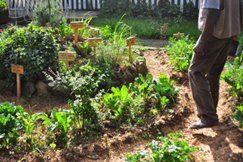
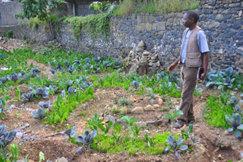
In Addis Abeba, in the heart of the Italian Piazza neighborhood, is the Taitu Hotel. The building dates back to 1898 and takes its name from emperor Minilik’s wife, who had the oldest hotel in Ethiopia built. Tichafa Makovere Shumba – coordinator of the One Thousand Gardens project in Ethiopia – has urned the hotel ornamental flowerbeds into an actual agro-ecological garden. The approach is that of "guerrilla gardening", namely gardening the green spaces spared by the aggressive overbuilding of cities. Several species are grown in this garden. In front of the hotel main entrance, welcoming guests, are indigenous varieties: ensete ventricosum (also known as false banana, a tree whose roots are the key staple food for the people of southern Ethiopia), hagenia abyssinica, kosso, and coffeea arabica, a very common crop on Ethiopian plateaus. A bit further away are a few specimens of Ethiopian wild olive trees, ruta graveolens, a shrub used for medicinal purposes, in the kitchen and as ornamental plant which can resist dry soils, and ocimum lamifolium, the African ancestor of our basil. Plants are distributed on various parcels which, taken all together, cover about one and a half acres. At the edges of the garden, a pergola of climbing beans protects hotel guests from intrusive gazes and helps fix nitrogen in the soil, enriching it with fundamental substances. In a more sheltered area, a few unused tires, washbasins and bathtubs have been recycled as pots to grow vegetables.
The design of the soil streaked by concentric canals allows to convey water, thus limiting wastes and erosion. Sowing at different stages allows a constant provision of vegetables and a continuous production throughout the year. This is possible wherever there is a bimodal rainfall pattern. Seeds are reproduced on site, selecting and drying the best specimens in the sun. Compost is obtained by fermenting brushwood and other scraps.
An advice of an Italian cook who has been managing the Taitu Hotel restaurant for a few months, was essential to choose the right varieties to plant and then use in the hotel kitchen. The result is a beautiful garden which produces fresh ingredients for customers as well as extra products sold at the local market. The Taitu Hotel vegetable garden also has a very important educational role. As it is located in a good and busy position, it can be accessed by both the hotel guests and the citizens of the Ethiopian capital city.
Area
Taitu Hotel, Addis Abeba
Coordinator
Tichafa Makovere Shumba