


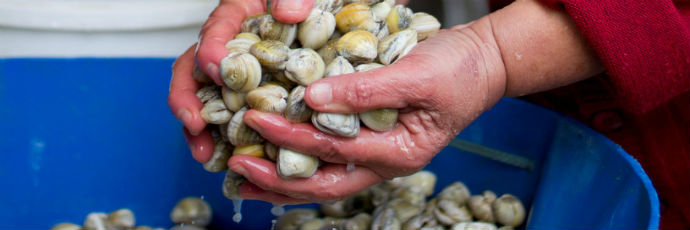
Berbigão (Anomalocardia brasiliana), also said Brazilian cockle – is a species of bivalve mollusk belonging to the Veneridae family which is found along the Brazilian coast. It has a trigonal shell reaching a length of 37 mm, height of 32 mm, and width of 23 mm in adults. It has a vitreous luster, yellowish color and often has dark grey wavy stripes or spots. The internal surface is hard and translucent with occasional grey marks on the back. Its diet mainly consists of phytoplankton (microalgae), suspended organic material and zooplankton. This mollusk is used as a food and source of income for fishermen. As it has high nutritional value, with significant vitamin content and excellent flavor, it is eaten by much of the coastal population. It is the principle ingredient in traditional ‘sopa do marisco branco’ (shellfish soup) or ‘sopa de berbigão’. Also known as ‘marisco-da-areia’ (sand shellfish), berbigão are abundant in the coastal areas of Santa Catarina state, growing in shallow areas where the land is 60% sand and 40% mud. They are considered adult after one year and the best time for harvesting is when 3-4 years old. In the past harvesting was done manually, but now simple types of artisan equipment made by the fishermen are used. They include rastéu or gancho, a sort of rake with a cage which is dragged along the muddy bottom of areas where the mollusks are buried. The rake usually has prongs with a spacing to immediately select the mollusks according to their size. Large sieve-like perforated buckets are also used to collect the mollusks, with perforated plastic trays carrying them in motor or sail-driven boats and traditional canoes. Fishing is currently permitted every day of the week (depending on the tide), with a limit of 9 containers of 18 liters per family. Each container provides about 1.4 kg of meat in the winter months. In summer the yield drops to 1.10 kg. The ideal period to ban fishing would be from November to February when the water is warmer. In this period the berbigão are more fragile and once caught do not survive more than 24 hours. In the winter months they stop growing and when they start again a mark forms on the shell which enables their age to be determined. The ideal size for harvesting berbigão is 20 mm and it is not permitted to use a rake with prongs spaced at less than 13 mm. After harvesting the mollusks are selected, rinsed in fresh water and left to soak in fresh water until the next day to remove any bitter or ‘smoky’ taste. They are then boiled and shelled the day after, with a thermal shock (immersion in ice with icy water) to help remove the shell. Berbigão are found from the West Indies to Uruguay and all along the Brazilian coast. They live in areas sheltered from waves and currents in the tidal strip and shallow shoreline waters, where they lie in the mud and sand layer near the surface. They are a human food and offer farming potential. On Santa Catarina Island and the adjacent mainland, where extensive colonies form, they are popular and available on the market. The Pirajubaé Marine Extractive Reserve (Resex) is located in the southern bay of Santa Catarina Island, in the urban area of Florianópolis, not far from the airport. It covers a total area of 1,444 hectares, 740 of which are mangroves of the Rio Tavares, and the remaining 704 hectares the Tipitinga sand bars. It can be accessed by sea or land from Costeira do Pirajubaé and Bairro dos Carianos. Resex, the first marine extractive reserve in Brazil, was created in 1992, with the objective of conserving the Rio Tavares estuary and helping the socioeconomic development of people traditionally using natural resources. The main activity carried out in the Reserve is the sustainable management of berbigão, whose reproduction had been endangered by unregulated harvesting. In 1996 a Usage Plan was published to ensure the sustainable use of the Reserve’s resources. In 1995 work began on the Via Expressa Sul, a high speed road linking the center of Florianópolis in the south of the island to the airport. Its construction lasted over 7 years and in its passage above the berbigão colonies of the Resex, it has caused extensive damage, a loss of biodiversity, and significant reduction in the stocks of berbigão. Thanks to support from the Chico Mendes de Conservação da Biodiversidade Institute (ICMBio), a Development Plan for the Pirajubaé Extractive Reserve is being implemented to improve the fishermen’s quality of life through training activities, professional courses and new forms of institutional partnership with private companies, public bodies and universities.
Image: Pedro Kuperman – Convivium Slow Food Mata Atlantica
Back to the archive >
