


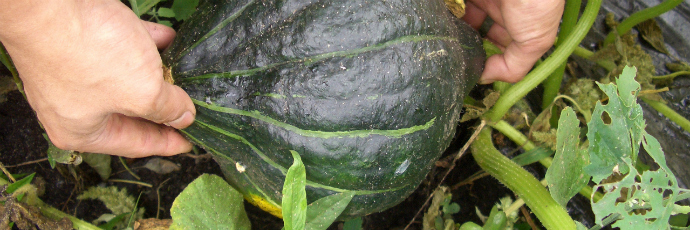
Masakari Kabocha
Cultivation of the Cucurbita maxima pumpkin in Hokkaido (one of the four main islands of Japan) goes back to the end of the 19th century. Until then only the Japanese pumpkin (Cucurbita moschata) was grown, a variety imported by the Portuguese during the Sengoku period (end of the 14th century) and spreading to Hokkaido during the Tenmei era in the Edo period (around 1780). Many western varieties reached the island of Hokkaido between the end of the 19th century and beginning of the 20th: in 1871 Marble Head was introduced to Sapporo (capital of the island of Hokkaido) and in 1878 the Hubbard began to be cultivated at the Agricultural University of Sapporo. Appreciated for its nutritional qualities and ability to keep for a long time, pumpkins were promoted and spread with the help of institutions that considered them essential for the diet of rural people, at that time engaged in preparing land for cultivation; it became a staple dish, along with okazu (a dish based on rice or bread crumbs). The Hubbard variety has an oval shape, very hard rind, and hard, floury flesh. It is a late cultivar bearing only a few fruit. Through natural selection this variety produced the Masakari pumpkin, whose name derives from its particularly hard rind: an axe (masakari) is needed to cut it. Its hard rind protects this variety from parasites, allowing it to be kept for a long time and making it the most popular variety. During the Second World War it was people’s main food. However, from the 1950s its cultivation fell dramatically. Only at the end of the 1990s was it rediscovered: to aid its revival research work was carried on the characteristics of twelve ecotypes of Masakari pumpkin. Its shape varies considerably (as does its color) and only one ecotype resembles the original Hubbard. Its skin is dark green. The orange flesh is floury and flavor superior to that of other varieties, even if slightly less sweet. The method of cultivation is similar to that used for other varieties: harvesting is from mid September to the beginning of October and it is consumed from November to January. It is essential to harvest at the right point of ripeness. To prevent the pumpkins from being burned by the sun, they have to be covered in the fields with hay and straw. Plants used for the production of seeds are separated from the others to prevent hybridization. Each ecotype of Masakari pumpkin is kept in the Center for Hereditary Plant Resources of Hokkaido. Unlike the Japanese type (C. moschata), which is seasoned when eaten, the Masakari variety can be consumed after steaming without special seasoning or sauces. It has been cultivated in Hokkaido since 1878. There are now 12 ecotypes.
Back to the archive >
