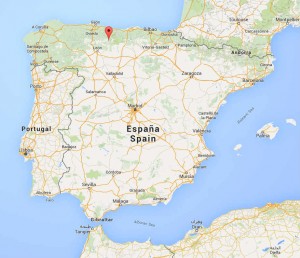
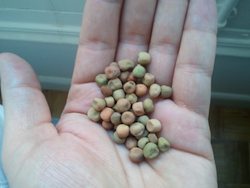
Arvejo peas are a unique, indigenous variety of Pisum sativum from northwest Spain, grown in the mountains of León, especially in the municipalities of Riano and Boca de Huergano, at about 1100 meters above sea level. It is a legume that belongs to the pea family, but with completely unique sensory characteristics. The plant is very well adapted to the local climatic conditions, and is a seasonal product that once dried can be used year round. It is planted in the spring, and the arvejo peas are harvested from the dried pods (containing, on average, 5 peas each) in late August. The plants, which grow best in stony soil, are sown from March to April with animal manure used as fertilizer. Seeds can be planted in rows or via dissemination. The difference between the arvejo and common pea plant can be seen at flowering, as the common plant has white flowers and the arvejo has blue ones. The two most pervasive pests for growing arvejo are the aphid and pea moth. The latter creates many problems and is one of the main reasons farmers are abandoning this variety. In addition, forest animals like boars and deer eat the fresh arvejos, exhausting fields before they can be harvested. However, solutions to combat aphid and the animals can be found in the use of freezing treatments in the first case, and in the use of electric fences for the later. Currently, arvejo is deeply rooted amongst the local people, with the cultivation techniques passed down from generation to generation. Its consumption is highly tied to the past and local traditions; one book from the first half of the twentieth century refers to their culinary use: ‘…a large port, which bubbled and danced with boils, the classic ‘arbejos,’ cooking with jerky, bacon and sausages stale.’ Sales of arvejo generally occur directly in homes, although there are retail shops in the town of Riano. There are currently only about six farmers who grow the crop, with uneven results due to weather conditions and other external factors. In Riano in 2012, 100 kg of arvejo were sold, with stock running out mid-season and no availability to replenish, due to an inability to find and additional supply of the crop. It is possible that more was sold directly at farmstead shops. In culinary use, the arvejo again differs from common peas because it is used mainly as a dry vegetable in meaty stews and soups accompanied with bread, dishes typical of the Riano Mountains area. The cooked peas have a pungent aroma and range from dark yellow to brown. Being a mealy legume, more similar to chickpeas, it perfectly absorbs the flavors of a stew’s meats, and provides a buttery smoothness without the sweetness of peas. It is also often served as an accompaniment to meat and vegetables (usually rutabaga or cabbage). Although it had been long used as fodder for livestock (mainly pigs), today, it is prized gastronomically. In recent years awareness of the variety has spread via gastronomic conferences and tastings at popular festivals. It is popularly consumed by both locals and tourists for as long as it is available. Nevertheless, arvejo has never been produced in large quantities, and today it is a variety well on its way of becoming extinct due to the decreasing number of farmers that grow it, regardless of its gastronomic and ecological value.
Back to the archive > Students of the Gastronomic Sciences at Pollenzo are collaborating with Slow Food to fill the Ark.