


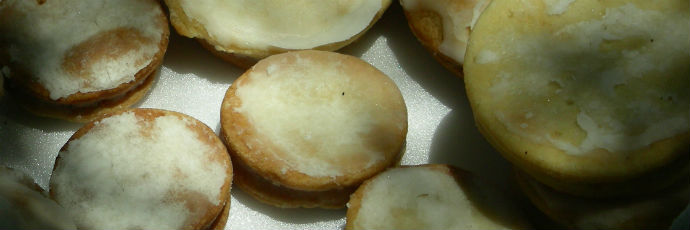
Rice pudding sweets have been part of the Chilean gastronomic tradition since colonial times. Each region, and sometimes each village, has one particular sweet whose preparation is confined to the specific area, making it typical and representative of the local traditions; though in general, the sweets are variations on dough stuffed with a rice pudding made from milk, rice, cinnamon, sugar and butter. They are made of a dough that is not very sweet, with fillings that vary from place to place. They are also sometimes called hojarasca (“fallen leaves”). Some are round and have a filling between the two layers. There are times that they are a little smaller or have three layers of dough. These are called chilenitos. There are also small sweet patties (empanadas) whose fillings are usually of jam or dried pears. Alfajores are another local variation. There are other slight variations in their preparation, each having its own name. Region IV, in north central Chile, particularly in the municipalities of Rio Hurtado and Interior de Combarbalá, is apparently the only area where the sweets are still found in some variations dating back to colonial times that are not seen in other regions of the country. Some local women still prepare the sweets for special occasions and traditional festivals. The dough is generally stretched and cut into small circles, and filled with the rice pudding. The sweets can be shaped like pockets, or made with multiple layers of dough. These rice pudding sweets can be found occasionally at local fairs and festivals, but are not widely available for purchase. They are mainly made by older women of the area, and there is concern that the tradition will be lost if not be passed on to younger generations, whose ideas of sweets are increasingly shaped by the industrially produced and marketed cakes and candies now available.
Image: Anabela Grunfeld
Back to the archive >
