


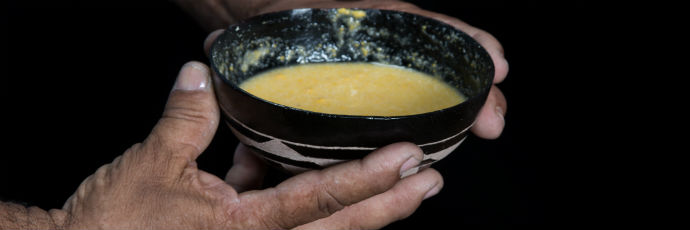
Mucujá (Acrocomia aculeata) is also known locally by many names, including: bocaiúva, macaúba, coco-baboso, macaíba, macaiúva, umbocaiúva, imbocaiá and coco-de-espinhos. It is a type of palm tree found throughout Brazil that produces a coconut-like fruit that is especially used in the Ourém municipality in the northern Brazilian state of Pará to produce a type of porridge made with the fruit, crab, rice and sugar.
Mucujá porridge or mingau de mucajá is a traditional food that came from miscegenation between Tembé Indians and riverside settlements. The fruit is available during three months a year, beginning in September. The mucujá palm usually is not cultivated, and the fruits used to prepare the porridge are harvested from the wild. The traditional recipe calls for the use of fruits that have naturally fallen from the trees. The typical preparation uses about 50 fruits that are cut into small pieces and placed together. Native aratu crabs, fished from the Guamá River, are then diced into the pestle containing the mucajá paste. After this paste is mixed together for about 90 minutes, it becomes homogeneous. Then it is placed in a bowl and covered with water and kneaded by hand. The mixture is then passed through a sieve, resulting in a diluted porridge that is yellow in color. This is then placed over a fire until boiling, and then about a kilogram of rice and a few pinches of salt are added and cooked until thickened. Then, one kilogram of sugar is added. The final product has a velvety texture.
Mingau de mucajá is a typical product of the Ourém community, but it has become increasingly rare. Passed down for generations, today there is just one producer who still makes it for commercial sale at the local market. Production is very time consuming, and the mucajá fruits must be gathered from nature. The production technique is not being passed down to younger generations, however, because it is believed that they should find another livelihood and source of income. Current production is extremely limited, both seasonally and by the lack of producers. The typical production method makes a batch of five liters, and it is estimated that only about 500 liters are sold annually. Despite its nutritional properties, the mucujá fruits are not cultivated, and the land where they grow is being converted into livestock grazing areas and mines. Also, according to popular folklore, mucajá is an aphrodisiac for women, who are discouraged from eating the fruit or porridge. Furthermore, the aratu crabs used are also negatively affected by mining activity. For all these reasons, without further attention, it is likely that mingau de mucajá will be lost in the near future.
Image: Marco del Comune & Oliver Migliore
Back to the archive >

